

Safety, quality and patient experience data
Where does VCU Health excel, and in which areas can we improve?
As part of our commitment to quality and safety, we strive to provide the highest quality experience and safest healthcare to all. And as a patient or family member of a patient, you must be an advocate for the treatment you receive at VCU Health and be given the information you need to make informed healthcare decisions.
Therefore, we make certain quality and safety information available to the public, and provide guidance on where to go online to learn more about our quality and safety scores.
The data displayed on this page is information specifically requested by patients and family members who serve on VCU Health's numerous volunteer advisory committees. This is information that they - not hospital staff - believe others need to know regarding their healthcare options. This information is gathered through manual reporting, surveys, and data extracted through our electronic medical records system.
Continual Improvement
Improvements to our quality and safety scores are constant. Progress has already been made in some of these key areas, and we are actively committed to doing better. Our commitment to the highest quality patient care for you and your family is led by VCU Health's mission. For VCU Health, ours is work with no defined ending, on a mission to preserve and restore good health for all people.
These figures are updated quarterly and is current as of January 2025.

The Mortality Rate is a measurement of the number of patients who pass away within 30 days of leaving a medical facility - typically after undergoing a more complicated procedure.
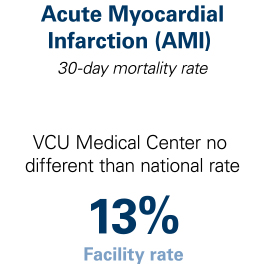
- The 30-day Mortality Rate for treatment of Acute Myocardial Infarction (AMI) — better known as a heart attack — is no different at VCU Medical Center than national rate, at 13%.
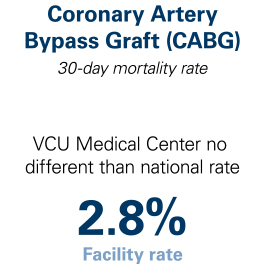
- The 30-day Mortality Rate for Coronary Artery Bypass Graft (CABG) — or open-heart surgery — is no different than national rate, at 2.8%.
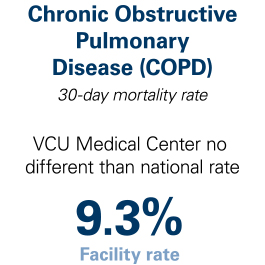
- The 30-day Mortality Rate for treatment of Chronic Obstructive Pulmonary Disease (COPD) — obstructed airflow to the lungs — is no different than national rate, at 9.3%.

Safety scores measure how well a hospital keeps its patients safe from infections and bacteria. It is especially important for those patients who are facing certain surgeries.
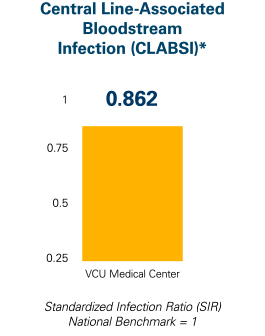
- The risk of Central Line-Associated Bloodstream Infection (CLABSI) at VCU Medical Center is no different than the National benchmark. A CLABSI occurs when bacteria enters the bloodstream through an IV line.
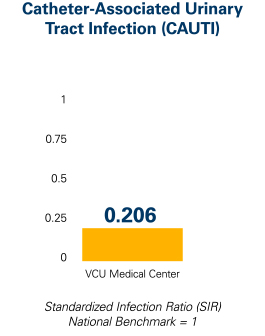
- The risk of Catheter-Associated Urinary Tract Infection (CAUTI) at VCU Medical Center is better than the National benchmark. Similar to a CLABSI, a CAUTI occurs when bacteria enters the urinary tract through a catheter.
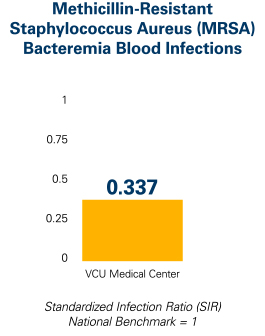
- The risk of Methicillin-Resistant Staphylococcus (MRSA) at VCU Medical Center is better than the National benchmark. Also known as a staph infection, MRSA can infect the skin and various other parts of the body. MRSA is usually treatable, but can be life-threatening.

How regularly are patients discharged, only to return to the hospital within a month? Readmission Rates to hospital systems like VCU Health are of critical importance, as readmission is costly for medical providers. In addition, hospitals are incentivized by Medicare for keeping older patients healthy and out of hospital rooms.
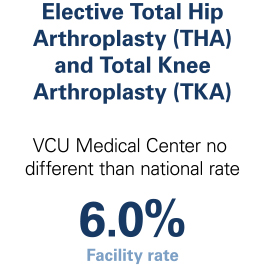
- The 30-day readmission rate following elective total hip reconstruction (arthroplasty) or total knee replacement is no different at VCU Medical Center as the National rate, at 6%.
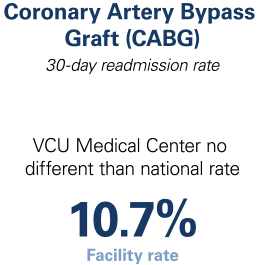
- The 30-day Readmission Rate after treatment of Coronary Artery Bypass Graft (CABG) — or open-heart surgery — is no different at VCU Medical Center as the National rate, at 10.7%.

No one chooses to go to the hospital. But once here, it is important patients and their family members receive a positive experience. How does VCU Health stack up against the national average and other hospitals in Virginia?
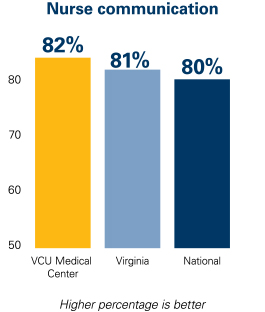
- How well do nurses communicate? 82% of VCU Medical center patients, 81% of patients in Virginia and 80% of patients nationwide say their nurses communicate well.
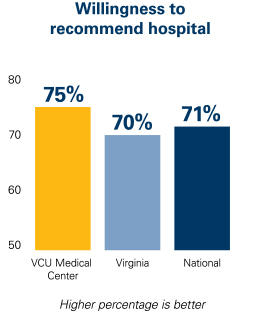
- How likely are patients to recommend their hospital? 75% of VCU Medical Center patients would recommend their hospital. Virginia-wide, 70% of patients would recommend their hospital experience to others. Nationally, 71% of patients would recommend their hospital.
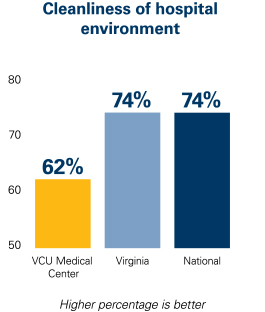
- How clean is the hospital environment? 62% of VCU Medical Center patients consider the hospital environment — in general, patient rooms and bathrooms — to be clean. Virginia-wide, patients consider 74% of hospital environment to be clean. Nationally, 74% of hospital environments are ranked as “clean” by patients.

When you receive treatment from a medical provider, you expect that care to be successful so that you can get back to living. Sometimes, you need to receive follow-up treatment. For patients who choose VCU Medical Center, how effective is the care they receive? These are key figures we monitor to keep you and your family safe and make your care even better.
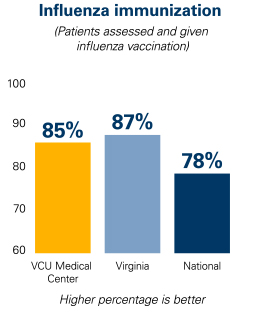
- 85% of VCU Medical Center healthcare personnel — individuals who are regularly around illness — are given an influenza vaccination compared to 87% statewide and 78% nationally.
More Safety and Quality Resources
We encourage all patients and their families to consult with multiple sources when making decisions about a hospital where they plan to receive care, or when considering any health care provider. If you would like additional information about the patient experience and quality scores at VCU Health or other hospitals or health systems:
- See the VCU Medical Center page at the Care Compare from Medicare.gov
- See VCU Medical Center's Cardiac Care ratings from Virginia Health Information
- VCU Medical Center has achieved the Gold Seal of Approval® from The Joint Commission, an independent non-profit organization that accredits and certifies health systems for meeting certain performance standards
If you have questions, comments or concerns, we want to talk to you.
For questions or comments on information listed above, contact:
- Email: PIQuestions@vcuhealth.org
- Call: 804-828-8731
For questions and concerns regarding patient care contact:
- Call: Patient Relations at 804-628-0400