VCU Health Pauley Heart Center first in Virginia to assess new therapy to prevent stroke
As part of a clinical trial, cardiologists are testing the effectiveness of a device that may help patients with atrial fibrillation, a common heart rhythm disorder associated with an increased risk of stroke.
April 06, 2026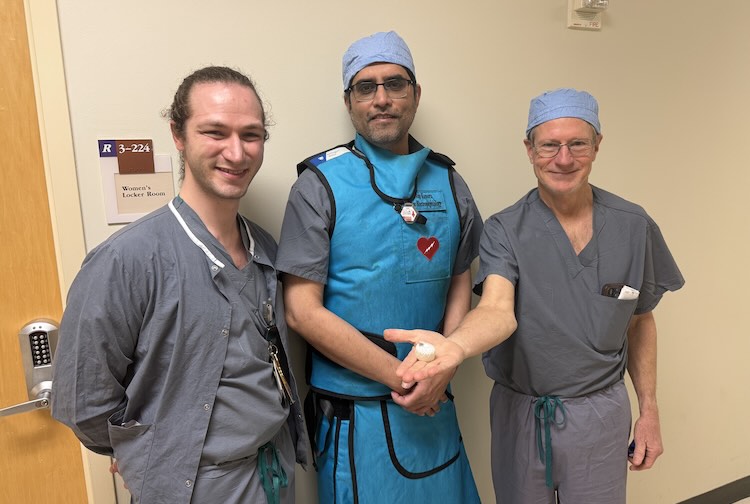 VCU Health Pauley Heart Center team members Caleb Bridgwater, M.S. (left); clinical research coordinator, Jayanthi Koneru, M.D. (middle); director of clinical cardiac electrophysiology and pacing, and Richard Shepard, M.D. (right); electrophysiologist, with the CLAAS AcuFORM Implant. (VCU Health Pauley Heart Center)
By Leigh Farmer
People living with atrial fibrillation (AFib), the most common heart rhythm disorder, have a higher risk of stroke. An estimated 10% to 20% of all strokes are caused by it. Now, cardiologists at the VCU Pauley Heart Center are working to lessen that statistic by being the first in Virginia to perform a novel clinical treatment.
Pauley doctors recently implanted a device which closes off a small portion of the upper left chamber of the heart where blood can pool and create clots. This treatment, the CLAAS AcuFORM Implant (2nd generation), is being studied in a nationwide clinical trial to determine whether it can lower the risk of stroke in people who have AFib and is designed specifically for patients for whom blood thinners are not an option.
“Blood thinners can help prevent strokes in people living with AFib, but some patients either can’t or don’t want to take these medications,” said Greg Hundley, M.D., director of VCU Health Pauley Heart Center. “For some patients, closing off the left atrial appendage, a procedure known as left atrial appendage occlusion (LAAO), is an alternative approach to help reduce stroke risk.”
The need for diverse LAAO therapies will increase as the AFib patient population grows. AFib is estimated to affect more than 10 million Americans, and the AFib patient population in the U.S. is projected to grow to 12 million by 2030.
A leader in research and innovative treatments for heart rhythm disorders
The Pauley Heart Center has long been a national leader in the treatment of heart rhythm disorders, a branch of cardiology known as electrophysiology, and in the field of left atrial appendage occlusion.
The CLAAS AcuFORM device is being evaluated to extend LAAO as a treatment option to patients with unique heart anatomies, as existing LAAO devices do not work with all anatomies. This novel device uses a foam matrix that is engineered to conform to each patient’s individual anatomy; the foam body helps to secure fit and seal within a wide variety of left atrial appendage shapes.
“Pauley is the leader for left atrial appendage occlusion in the state of Virginia,” said Jayanthi Koneru, M.D., director of clinical cardiac electrophysiology and pacing at the Pauley Heart Center. “Our goal is to evaluate whether this approach can expand options for patients with more complex anatomies.”
Koneru and fellow Pauley electrophysiologist Richard Shepard, M.D., performed the first Conformal implant on a patient at VCU Health on February 10. VCU Health is participating in the CONFORM Pivotal Trial, which is evaluating the CLAAS AcuFORM Implant compared to other widely available LAAO devices in patients with non-valvular AFib. The CLAAS AcuFORM Implant is not currently available to patients outside of the clinical trial.
Pauley’s electrophysiology team has pioneered innovative treatments for AFib and LAAO for more than three decades and was among the first three hospitals in the United States to perform catheter ablation for AFib in 1998 — a procedure that has since become the standard treatment for the most common heart rhythm disorder. Pauley cardiologists were involved in the original clinical trials for the WATCHMAN device — the first LAAO device approved for use by the U.S. Food and Drug Administration in 2015 — and continue to be involved in large clinical trials to evaluate the effectiveness of the device compared to other treatments.