From patient to advocate, Johnny Boatman takes amyloidosis to heart
The VCU Health patient once considered himself the epitome of health, but an amyloidosis diagnosis changed everything.
October 07, 2026 Fredericksburg residents Quan and Johnny Boatman are grateful to VCU Health for saving Johnny’s life following an amyloidosis diagnosis that led to a heart and kidney transplant in 2024. The couple is now passionate about raising awareness of the disease, which disproportionately impacts Black communities. (Daniel Sanjib Min, MCV Foundation)
By Holly Prestidge
On a fall day in September 2022, Johnny Boatman was working out at his local gym with a time bomb in his chest.
Had he known then what he knows now, the events over the next few hours might have been avoided. It was his genetics — not his physical shape — that tried to control his fate.
Minutes into his cardio workout, he noticed some chest pain. He was unusually sweaty. He tried stretching and moving around, but the pain persisted.
It wasn’t alarming, he said, but it spooked him enough that he took himself to an urgent care facility where he was informed that he was having a heart attack. Within 15 minutes he was in an ambulance on his way to a local hospital.
Life as he knew it would never be the same.
That initial hospital stay resulted in surgery for a blood clot. But that was just the beginning. For the next 18 months, Johnny was in and out of urgent care centers and hospitals as his heart deteriorated.
He developed atrial fibrillation in 2023, then needed cardiac ablation by January 2024. By April 2024, his local doctors had referred him to VCU Health, where he was officially diagnosed with hereditary amyloidosis.
By the end of that summer, he was in end-stage heart failure. VCU Medical Center’s downtown Richmond campus became his home away from home for more than four months, while he waited on the national transplant list for both a new heart and kidney.
All the while, Johnny and his wife Quan were reeling from a word they had never heard of.
“We were just not prepared,” Quan said. “We had never heard of amyloidosis, and we don’t live under a rock – how could it be so prevalent in the African American community and be so impactful and yet we didn’t know about it?”
“You’re talking about a guy who had been really healthy, thought he had a good heart, and now he’s having to rely on someone else’s heart to live,” Johnny said. “Quan and I were just wrecked.”
Johnny and Quan Boatman share their experience with VCU Health Pauley Heart Center and Hume-Lee Transplant Center. (Will Rummel, MCV Foundation)
Cardiac amyloidosis: A disease hiding in plain sight
Amyloidosis occurs when proteins misbehave.
Proteins play vital roles within the body, transporting nutrients, building and repairing tissues, and regulating organ function. They’re made of amino acids that bind and form structures, but when they become unstable and lose their structure, they create sticky, misshapen clumps.
Those clumps form amyloid, a pink, shapeless substance that oozes into spaces between cells and destroys healthy tissue, which over time leads to organ failure.
In the heart, amyloid causes muscles to become thick and stiff, leading to heart failure, valve disease and arrhythmia.
Eventually, over time, amyloid build up keeps the heart from contracting the way it should. If it goes undetected, the individual can die suddenly – often appearing like a heart attack.
Keyur Shah, M.D., knows all too well that for many people who die of a supposed heart attack or heart failure, the real culprit in many cases is amyloidosis.
As the interim chief of cardiology and David E. Tolman Professor in Heart Failure at the VCU Health Pauley Heart Center, Shah specializes in advanced heart failure and heart transplantation. Since joining the health system in 2009, he has built an amyloidosis clinic that puts VCU Health squarely among the ranks of the best treatment centers in the world.
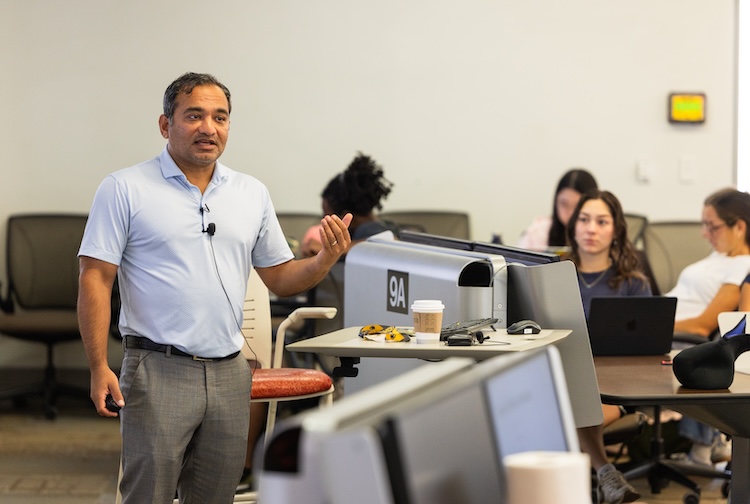 Keyur Shah, M.D., teaches second-year medical students about amyloidosis. Dr. Shah leads a world-renowned amyloidosis clinic at VCU Health. (Daniel Sanjib Min, MCV Foundation)
In the early 2000s, amyloidosis was considered rare and had no treatment options. Shah soon discovered that it was actually misdiagnosed, often. Its symptoms mimic other conditions and can affect multiple organs simultaneously. At the time, the only way to confirm the presence of amyloid in the heart was to do an invasive biopsy, something doctors avoided unless they were sure it was warranted.
When his patient died several months later, the reported cause of death was a heart attack.
“Not a heart attack,” Shah said matter-of-factly last month. “That patient died from amyloid, but no one knew what it was or how to describe it.”
Because it was labeled a genetic disorder, the real cause – and the warning it carried – was missed.
“At that time, amyloidosis was perceived to be terminal; nobody knew much about it, and nobody understood there were different types,” Shah said.
So much has changed, including a growing awareness of the disease’s prevalence.
In August 2026, more new patients were referred to VCU Health for amyloidosis than general heart failure, prompting Pauley Heart Center to expand its amyloidosis clinic two full days per week. The success of the clinic stems from its multidisciplinary team of providers, physicians and surgeons that span cardiology, medical oncology, neurology and nephrology, and organ and stem cell transplantation.
The vast resources of an academic health system like VCU Health include advanced imaging procedures to help doctors see how a heart moves and beats, so they spot amyloid early.
And ongoing clinical trials, for which Pauley was among the first in the country several years ago to offer access, continue to expand.
“We have the ability to offer every component of care for treating amyloidosis patients,” Shah said.
It’s an exciting time for those [amyloidosis] patients who previously had no treatments. But the onus is on us to identify and diagnose this disease early.
Keyur Shah, M.D., head of the cardiac amyloidosis clinic at VCU Health Pauley Heart Center
That matters considering there are three main types of amyloidosis that affect the heart, each requiring a different approach.
Light chain amyloidosis, or AL, often referred to as primary amyloidosis, occurs when bone marrow produces too much amyloid protein.
Age-related amyloidosis, or acquired ATTR, is sometimes called wild-type amyloidosis and stems from a liver protein called transthyretin (TTR) that accumulates in the heart and leads to heart disease in patients over 60.
In Johnny’s case, hereditary amyloidosis, or hereditary ATTR, is caused by a mutation in the TTR gene. It stems from West Africa.
One in 25 Black Americans have this mutation.
It’s a staggering statistic that makes early detection critical. VCU Health addresses it with a three-pronged approach to education and awareness – medical students and residents, providers and patients.
“I’m trying to convince healthcare providers to look for amyloidosis years before it becomes severe,” Shah said. “The window for early diagnosis has 10 to 15 years of lead time because the protein starts depositing in other places much earlier than it starts causing symptomatic heart disease.”
That means reaching out beyond cardiologists’ and neurologists’ patients, who are most often seen at the end stage. Rather, he wants to reach primary care providers, geriatricians and orthopaedic surgeons who can spot the earliest clues – symptoms that don’t look heart-related at all.
Shah has found that hereditary amyloidosis patients often had carpel tunnel syndrome earlier in their lives. They deal with nerve compression issues in the sciatica or lumbar regions, and they’re more likely to have shoulder, knee or hip surgeries or replacements. Another common factor: spontaneous bicep tendon rupture, which results in an oddly large bicep, something doctors call a ‘Popeye’ bicep
“The picture we’re painting here is that patients with amyloidosis have multiple orthopaedic and neuropathy-type symptoms that present many years before they have problems with their heart,” he said.
At VCU Health, care spans both ends of the disease. Early intervention can slow or even stop the progression of amyloidosis. For those with the worst-case scenarios, Pauley Heart Center and the VCU Health Hume-Lee Transplant Center stand ready to provide second chances thanks to a robust transplantation program.
“It’s an exciting time for those patients who previously had no treatments,” Shah said. “But the onus is on us to identify and diagnose this disease early.”
Organ donation: A long-awaited gift
In the waning months of 2024, while waiting for a heart and a kidney, Johnny and Quan celebrated milestones and holidays among the hallways and conference rooms of VCU’s Main Hospital.
Red velvet cupcakes on their anniversary in September.
Cake and ice cream for Johnny’s birthday in October.
Thanksgiving turkey and dressing and pies and all the fixin’s were accommodated by hospital staff, who arranged for immediate and extended family – including Quan’s 96-year-old grandfather – to celebrate Thanksgiving together in a hospital conference room.
“They made the hospital feel like home, and those small gestures helped me mentally prepare for what I had to go through,” Johnny said.
“Nurses from other areas of the hospital would stop by and say hello even though they manage many other patients,” he said. “They were going the extra mile, and you can’t teach that. It’s something that’s just inherent and it’s very special.”
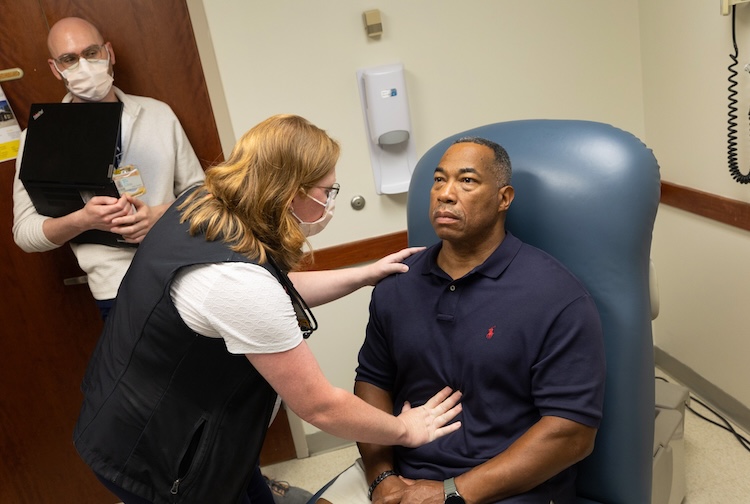 Johnny Boatman visits VCU Health regularly for heart and kidney check-ups following his transplants in December 2024. (Daniel Sanjib Min, MCV Foundation)
Christmas came and went. Johnny and Quan wore matching pajamas.
Then came word of a long-awaited gift: a donor.
On Dec. 27, Johnny received a new heart. Two days later, a new kidney. After another month in the hospital ensuring his body could accept the new heart, Johnny went home on January 31.
“Without organ donation,” he said, “I wouldn’t be here today.”
‘This is bigger than you'
Last month, Johnny stood before nearly 100 second-year medical students at the VCU School of Medicine and told his story.
The following week, he and Quan – along with Shah – appeared on a webinar for VCU Massey Comprehensive Cancer Center’s Facts & Faith Fridays, an outreach program that partners with the Central Virginia faith community to get important medical information into communities that need it.
The Boatmans’ priorities now center on making more people aware of amyloidosis. Johnny and Shah both serve on the Amyloidosis Speakers Bureau, a national organization that gives amyloidosis patients a platform to share their personal stories with medical students and resident physicians all over the country.
The Boatmans consider themselves parters in VCU Health’s mission to educate, diagnose and treat amyloidosis.
“I’ve been surprised how my relationship with VCU Health has grown, and I think that’s because our value systems are the same,” Johnny said. “When we decided we wanted to do outreach, VCU Health welcomed us with open arms.”
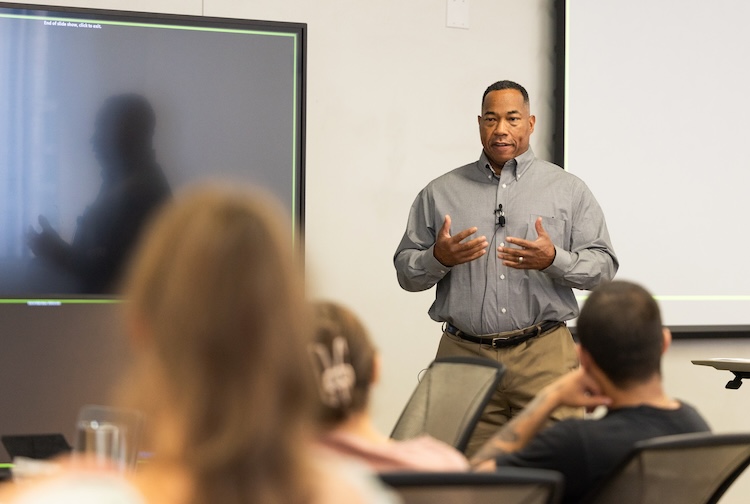 Johnny Boatman speaks to Dr. Shah’s class of second-year VCU medical students earlier this year about his amyloidosis diagnosis and how it impacted his life. (Daniel Sanjib Min, MCV Foundation)
It was Quan, who, during Johnny’s long hospital stay, planted that seed.
As they waited all those months for a donor, she created a Facebook page called “Anyone With a Heart.” It highlighted Johnny’s ordeal and their harrowing journey through it, from the initial surprise and shock to the ongoing medical treatment pre- and post-transplant.
Part plea, part educational tool.
Johnny wasn’t keen on social media outreach. He’s never been comfortable in the spotlight.
“Quan said to me, ‘this is bigger than you – people are dying,’ and when she put it like that, it made sense that this was something I had to do,” Johnny said. “This isn’t just about me; this is about a generation of folks who have this disease and who are dying and don’t even know it.”
During those long months waiting for a heart, Johnny made a deal with God.
“I’ve always been grounded in my faith,” Johnny said, “and I told the Lord that if this is something you want me to do, open the door and I won’t say no.”
Johnny is living proof that organ donation saves lives. He also knows, however, the stigmas and fears that persist within many Black communities about organ donation and body autonomy. When he talks to community groups or church congregations, he simply shares his story and lets people decide for themselves.
“I’ve been given this gift of life because someone pledged their organs,” Johnny said. “It’s humbling and I am so grateful for it.”
Amyloidosis treatments: Heart specialist shares insights on the latest advancements and research
A version of this story was originally published by the MCV Foundation.