What to know before a cardiac MRI: Safety, comfort and what this heart test can reveal
Feeling anxious about a cardiac MRI? VCU Health Pauley Heart Center specialists explain what to expect, how we keep patients safe and why this test can reveal what other scans can’t.
April 22, 2026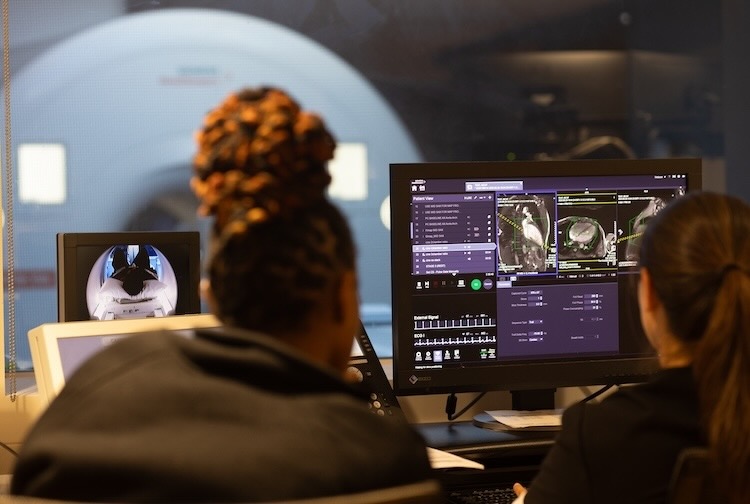 VCU Health Pauley Heart Center’s Cardiac Imaging Suite is located at VCU Medical Center. (Tyler Trumbo, MCV Foundation)
By Tanner Lambson
Cardiac magnetic resonance imaging (MRI) can provide answers when other tests come up short. It’s not a tool available at every hospital. However, at VCU Medical Center, this level of imaging helps doctors understand more about the heart when diagnosing a patient – not just “what” is happening but “why.”
“The heart is a challenging organ to image because it’s constantly moving, but with cardiac MRI, we can synchronize with your heartbeat to create clear images that allow us to see your heart’s structure, motion, blood flow and more,” Cory Trankle, M.D., cardiologist at VCU Health Pauley Heart Center.
VCU Health Pauley Heart Center’s Cardiac Imaging Suite is located on the ground floor of VCU Medical Center, in the heart of downtown Richmond. The suite is led by Greg Hundley, M.D., director of the Pauley Heart Center, who was the first in the world to use MRI to visualize and measure blood flow in coronary arteries, and the first to demonstrate that MRI stress testing can identify those at risk of heart attack.
To help you feel prepared, we sat down with Trankle, who is also an associate professor at Virginia Commonwealth University School of Medicine and associate program director for research with VCU’s Internal Medicine Residency program, to answer some of the most common questions patients have about cardiac MRI.
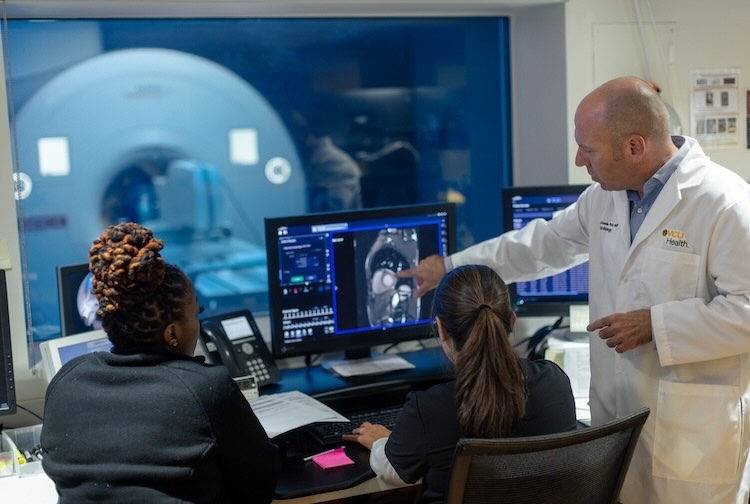 Cardiac MRIs help clinical teams get a better picture of the heart’s structure and how it is moving, which can lead to a more accurate diagnosis. (Tyler Trumbo, MCV Foundation)
What is a cardiac MRI? What makes it different from other scans?
Cardiac MRI uses an extremely strong magnet and radio waves to generate images, which means it does not rely on radiation like x-rays or CT scans.
Something many people don’t know is that while other imaging methods only provide one type of view, cardiac MRI can take many views of the heart. With just one exam, we can know about the shape and size of your heart, how it is moving, whether a valve is tight or leaky, if there is scarring and so on. It’s several techniques bundled in one imaging method.
Why do doctors order cardiac MRIs?
There are many potential reasons, but the most common is when a patient has cardiac-related symptoms that need an explanation that hasn’t been determined by other methods.
As Dr. Hundley puts it: “Cardiac MRI is great at answering the question ‘why?’” This is because a cardiac MRI is so detailed that it helps us make more accurate diagnoses and choose treatments tailored specifically for your heart.
What is a cardiac MRI stress test? Do I have to exercise during it?
For many heart conditions, people only notice symptoms during physical activity. A stress test is one way to see how your heart performs when it’s working hard. Cardiac MRI stress testing helps recreate those exercise conditions without and within your body safely so we can see how your heart responds.
During a cardiac MRI stress test, you may be “stressed” in one of two ways:
- Medication-based stress test: A medication is given through an IV to mimic the effects of exercise within your body. As the stress medication takes effect, people often describe feeling side effects such as shortness of breath or even chest tightness. These symptoms do not typically mean that anything is wrong or that the stress test will be abnormal – they are simply what it feels like as the medication stresses the heart. You then lie still in the scanner while we take images. This approach is precise, safe and controlled.
- Exercise stress MRI: This is a type of specialty MRI offered at only a handful of hospitals worldwide — and the Pauley Heart Center is one of them. Patients pedal on a specialty “MRI-compatible” bicycle while lying down inside the scanner itself. Most people won’t need to do an exercise stress MRI, but it’s valuable for patients with certain conditions, such as atherosclerosis or recently diagnosed heart failure.
For both tests, there is typically a nurse in the scanner room with the patient, who is monitoring the vital signs along with the technologist team in the control room. They are prepared to stop the test and, in the case of the medication-based test, reverse the stress medication if needed.
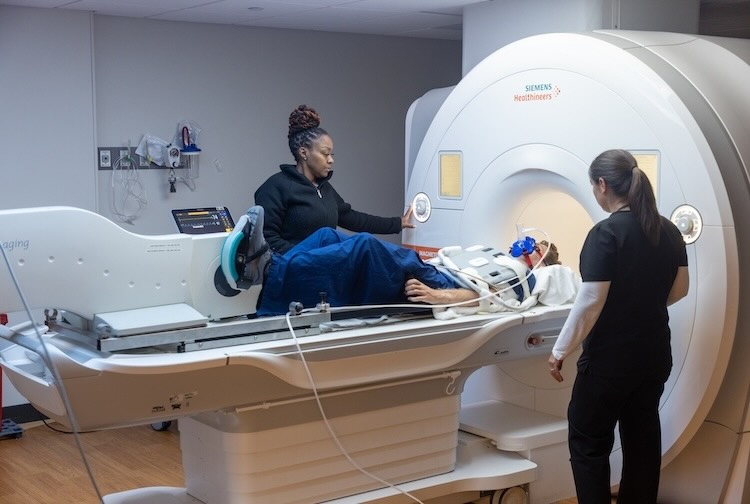 For cardiac MRI exercise stress testing, patients pedal on a specialty “MRI-compatible” bicycle while lying down inside the scanner. (Tyler Trumbo, MCV Foundation)
Can I still get a cardiac MRI if I’m claustrophobic?
Yes. Claustrophobia is common, and the whole team is experienced in helping patients through it. They are in constant contact with you during the exam and can offer calming medications if needed. Many patients with claustrophobia complete the scan successfully.
Luckily, newer MRI machines are built wider and have more open space than older models. Today, our scanners are 70 centimeters wide compared to an older standard of 60 centimeters.
If you’re nervous, let your care team know ahead of time. We want you to feel comfortable and supported.
What makes the Pauley Heart Center’s cardiac MRI program unique?
Because cardiac MRI is one of our most advanced imaging techniques, I’ve been able to meet patients with some of the rarest and most complicated conditions that we treat at the Pauley Heart Center.
Our stress MRI test is also something that is very unique about our program. Because it’s such a high-performing, top-tier test, its accuracy is unmatched. Another reason people come to us is for the exercise stress MRI, which most had never even considered a possibility.
The Pauley Heart Center also has several research programs that are using the precision of cardiac MRI to drive discoveries to improve diagnosis and treatment for several conditions, including heart disease in cancer patients, atrial fibrillation, heart failure, hypertrophic cardiomyopathy and much more.