At the Heart of Health: VCU Health neurologist’s bold artwork illustrates how it feels for patients to live with neurological diseases
With pieces published in leading academic journals, Usaamah Khan’s abstract oil paintings educate healthcare workers and foster compassion for their patients.
October 01, 2026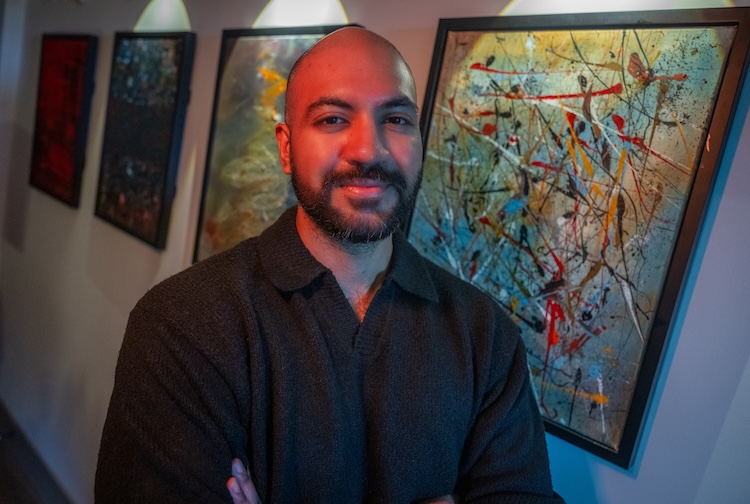 Usaamah Khan, M.D., is a neurologist and neurointensivist at VCU Health. (Dean Hoffmeyer, Enterprise Marketing and Communications)
By Joan Tupponce
Usaamah Khan, M.D., can’t tell you whether it was Oliver Sack’s book, “The Man Who Mistook His Wife for a Hat: And Other Clinical Tales” or a medical TED Talk that sparked his interest in painting.
What he can tell you is that the concepts detailed in the book and in the Ted Talk about bizarre and complex neurological diseases prompted him to search for a deeper understanding of what his patients were feeling and experiencing.
He found that kinship through abstract art.
“I’m not someone who grew up with polished art skills,” said Khan, associate medical director of the Neurosciences Intensive Care Unit at VCU Health, the largest neurocritical care unit in Virginia. “Abstract art allowed me to improvise and be fluid. It gave me creative liberty and license, and I leaned into that.”
One of Khan’s first pieces, “Prosopagnosia,” was inspired by the neurological disease of the same name. It causes facial blindness, meaning patients can’t recognize faces.
“The concept blew me away. I remember trying to understand what that feels like for patients,” he said.
With oil paints, Khan illustrates a woman whose facial features have been replaced with vividly colored broad, bold brushstrokes, depicting the distortion the patient experiences when she looks at another person and the intense feelings it evokes.
“This painting is an embodiment (of sorts) of an otherwise indescribable experience. If you look long enough, a distorted face begins to emerge but without any actual identifiable features,” Khan said. “The abstractness of the piece that creates an illusion of confused chaos, parallels what one can only imagine as the mysterious phantasm reminiscent of a patient's experience."
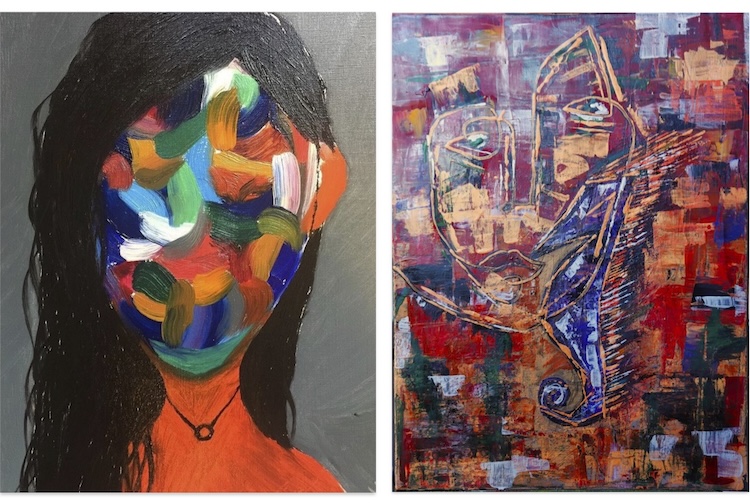 Prosopagnosia (left) depicts a patient who has a neurological condition of the same name, which impairs a person's ability to recognize faces. Sclerosis (right), one of Khan’s favorite paintings, is based on a patient living with temporal lobe epilepsy. (Contributed photos)
These visual narratives of complex neurological diseases, Khan believes, merge two different worlds — art and neurology.
“That’s where the name of my portfolio of work, Neural Blends, comes from,” he said. “I aim to foster understanding, empathy and a deeper connection to the human experience.”
This intricate blend of interests has journeyed with him since graduating from Virginia Commonwealth University School of Medical and completing residency at VCU Medical Center, as well as during two fellowships at Boston Brigham Women’s Hospital. Khan returned to VCU Health in 2025, where he specializes in neurocritical care, because he wanted to work at an institution where he could practice across multiple disciplines.
“VCU Health is a leader in these disciplines and has a rich history in neurotrauma, a state-of-the-art neuroscience intensive care unit and comprehensive stroke and epilepsy programs,” he said. “As a prior chief resident at VCU Health, I was particularly invested in the continued growth and development of this program. Joining the faculty has been immensely rewarding.”
Depicting the nervous system ‘more like a story’
While Khan’s art started as a personal outlet and a way to challenge his creativity, it has become much more.
“It has been rewarding,” he said. “When I started sharing it with people, I came to realize there is an educational component there too. If trainees looked at my art, they would immediately be able to remember different aspects of that specific neurological disease by associating with the art.”
His work has received praise and notoriety both in and outside the medical community.
For two consecutive years, Khan has been invited to The American Academy of Neurology annual conference to lead an art and neurology session.
“The session focuses on neurology trainees learning about different diseases through the artwork,” he said. “That’s something I have come to enjoy."
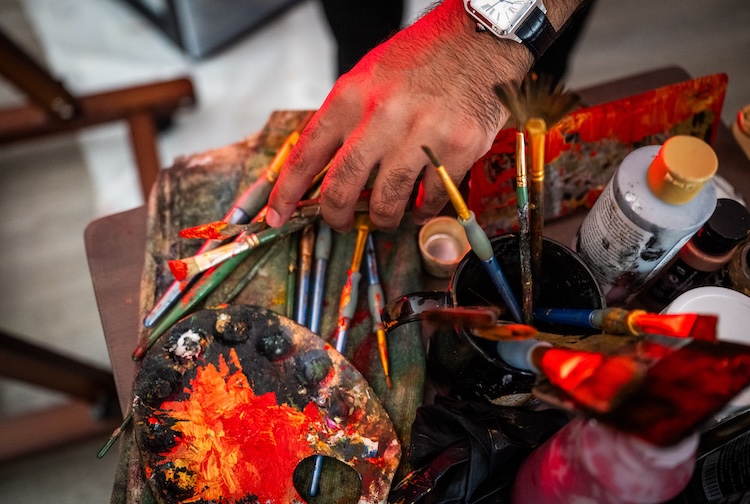 Khan paints abstract art that captures the emotions and experiences of patients with neurological disorders. (Dean Hoffmeyer, Enterprise Marketing and Communications)
Aarti Sarwal, M.D., a professor of neurology at VCU School of Medicine, discovered Khan’s talent at an American Academy of Neurology annual meeting when she looked at the program and saw his name on one of the sessions.
“I had met him before and knew he had signed up to come to VCU. The topic he was discussing excited me so, I went to his session to check it out,” she said.
“His work,” she continues, “combines anatomical precision with emotion and imagination. He makes the nervous system feel less like anatomy and more like a story. Neurologists may recognize additional layers because we understand the science, but the human themes make his art are accessible to everyone.”
Sarwal is a proponent of having a creative outlet.
“It gives physicians space to process experiences that clinical language cannot always capture,” she said. “Creative outlets help preserve curiosity, empathy and joy. Doctors are people too. Art is a great way to recharge your soul.”
When I started sharing it with people, I came to realize there is an educational component there too. If trainees looked at my art, they would immediately be able to remember different aspects of that specific neurological disease by associating with the art.
Usaamah Khan, M.D., a neurologist and neurointensivist at VCU Health
Khan’s artwork was also showcased at the New England Epilepsy Society gala, where the parent of a patient with epilepsy told Khan they were moved that a doctor was looking at epilepsy from such a humanistic prospective. Khan said the parent told him that the art had added an element of beauty to a challenging disease.
“It was nice to hear,” Khan said. “I was really humbled by that.”
Khan’s art has graced the covers of two professional publications: Neurology, the premiere journal of the American Academy of Neurology and Academic Medicine, the peer-reviewed journal of the American Association of Medical Colleges.
“Journal space for artwork is limited and highly competitive,” Sarwal said. “Having artwork selected is a significant recognition because it means the work succeeds both artistically and academically.”
Blending neuro pathways and compassion for patients
Khan continues to display his work at museums and conferences. Having the opportunity to talk about his art and engage with people is very meaningful to Khan.
“I have a special relationship or connection with the story behind the art,” he said. “I really want to be able to tell them what the story is and also let them interpret it in their own way as well."
He values the direct feedback from those living with complex neurological diseases, especially people who are more familiar with Khan in a polished medical white coat – and not a comfortable hoodie that carries the marks and remnants of his many pieces of art.
"When I'm in an artistic headspace, I am fully removed from the cleanliness and spotless aesthetic one imagines on a white coat. The only thing spotless is the canvas at the very start of the journey,” he said.
He’s thrilled that his art is actually reaching patients that he has been caring for.
“Many of them expressed how they had done some artwork too,” he said.
Being able to connect with people that share a similar interest is something Khan hopes to build upon in the future. He would like to use art as a form of therapy and neurological recovery, something he did when he was in Boston.
Art brings people together, he adds.
“I would like to do more advocacy work and if art can be used as a tool, that would be really exciting.”
As a senior neurologist and mentor who had advised Khan about a career in neurocritical care when he was a resident, Sarwal believes that creativity strengthens clinical thinking.
“Dr. Khan simply takes that connection to an exceptional level,” she said.
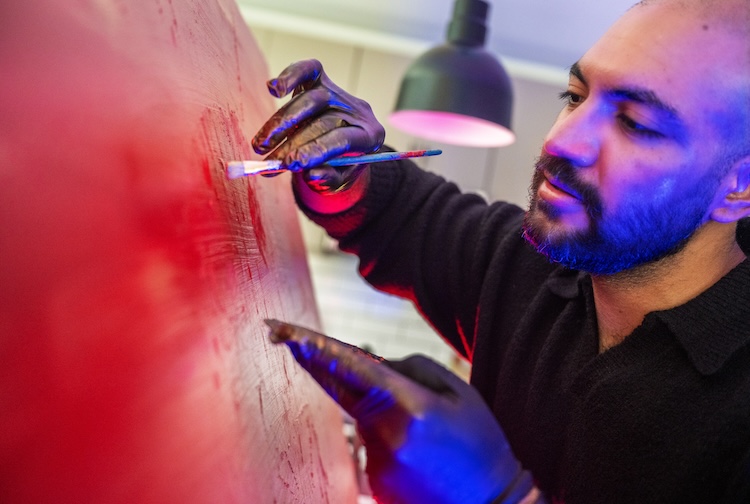 Through art, Khan says he is able to connect with patients, caregivers, healthcare workers and community members on another level. (Dean Hoffmeyer, Enterprise Marketing and Communications)
This story is part of a VCU Health News series called “At the Heart of Health,” which spotlights VCU Health and VCU team members whose passions outside of the workplace inspire and support the community.