

 Back to search results
 (804) 828-9350
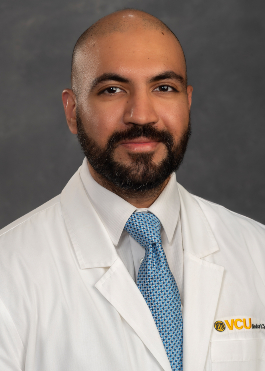
 Usaamah M Khan, MD
Locations
1250 E. Marshall Street
Richmond,
VA
23219
 Get directions
 VCU Health Way finder
Education
Medical School
Ross University School of Medicine-Dominica
Residency
VCU School of Medicine
Internship
VCU School of Medicine
Fellowship
Massachusetts General Hospital
Biography
Where Urgency Meets Compassion in Neurological Care
When seconds can mean the difference between recovery and permanent disability, Usaamah Mahmood Khan, M.D. thrives in the fast-paced, high-stakes world of neurocritical care.
As the recently appointed Associate Medical Director of the Neurosciences Intensive Care Unit at VCU Health—Dr. Khan specializes in caring for patients facing some of the most serious neurological and neurosurgical emergencies, including acute stroke, brain hemorrhage, traumatic brain injury, seizures and spinal cord injury.
“Time is of the absolute essence,” said Dr. Khan, who also serves as an Assistant Clinical Professor in the Department of Neurology at the VCU School of Medicine. “The brain is a highly time-sensitive organ and early detection, and treatment of conditions can be lifesaving.”
A neurologist and neurointensivist, Dr. Khan served as chief resident during residency training at VCU before pursuing dual fellowships in neurocritical care and epilepsy at the Harvard Medical School-affiliated Massachusetts General Hospital and Brigham and Women’s Hospital in Boston. His expertise spans neurocritical care, vascular neurology, Epilepsy and electroencephalography (EEG), giving him a unique perspective across multiple neurological subspecialties.
He treats a wide range of complex conditions, including acute stroke, brain hemorrhages, status epilepticus, traumatic brain injury, autoimmune encephalitis, myasthenia gravis and neuromuscular emergencies.
In the NSICU, Dr. Khan leads multidisciplinary teams — collaborating with everyone from neurosurgeons and anesthesiologists to nurses, respiratory therapists, pharmacists, rehabilitation specialists, social workers, and others. He also works closely with EMS and emergency medicine teams to ensure patients receive timely, coordinated care.
“One of the most rewarding aspects of my work is the opportunity for collaboration with so many healthcare professionals and team members,” he said.
After completing his fellowship training in New England in 2025, Dr. Khan returned to Richmond to help shape the future of neurological care and education.
“VCU Health is an exciting place to be as it continues to become a leader in medical innovation, advances in research and championing efforts to provide world-class clinical care to its patients,” he said. “I am most excited about growing in my role as a healthcare provider but also a medical educator for the amazing residents and fellows we work alongside.”
As Associate Medical Director of the NSICU, Dr. Khan is focused on expanding inpatient services and strengthening the comprehensive care available to patients and families across the region.
While caring for patients with devastating neurological injuries can be emotionally challenging, Dr. Khan views helping families navigate difficult moments as one of the most meaningful aspects of his work.
“It is a huge privilege and honor to help patients and their families navigate through some of the most difficult moments of their lives,” he said. “There is a sense of purpose I feel in being able to help provide closure and clarity to families in situations that can often feel overwhelming to process.”
Beyond the hospital, Dr. Khan combines his passion for neurology and visual arts through Neural Blends, a nationally recognized portfolio of abstract artwork inspired by neurological diseases and real-life patient experiences. His work has also been showcased at conferences and featured in journals.
An avid runner, Dr. Khan enjoys exploring Richmond’s James River trails and playing Squash.
Advice to patients: “Don’t ignore symptoms or delay seeking medical care. In acute stroke care, time is of the absolute essence and oftentimes our ability to provide certain therapies are contingent on the duration of a patient’s symptoms. Therefore, the earlier something is recognized and assessed, the more treatment options are available to us. The brain is a highly time sensitive organ and early detection and treatment of conditions can be lifesaving.”
Ratings & Reviews
Learn More About the Press Ganey Survey
In order to provide our patients and visitors with the most accurate and useful information, we only post physician satisfaction data when a physician has received a minimum of 30 returned surveys. For this provider, we have not yet received the minimum.