Training the next generation of cardiac perfusionists at VCU
Recognizing a shortage in the health care workforce, VCU and VCU Health develop a new graduate program for a growing field.
December 03, 2025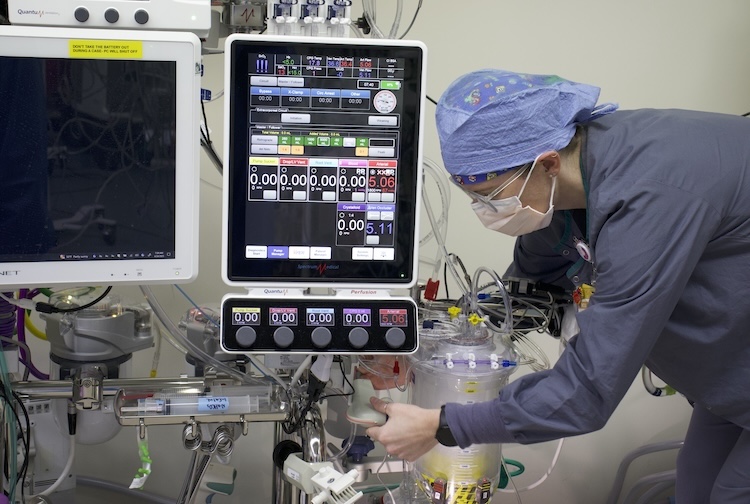 A VCU Health cardiac perfusionist prepares for surgery. (VCU College of Health Professions)
By Liz Torrey
A critical job in open-heart surgery is maintaining a patient’s blood circulation, effectively keeping them alive during the operation.
Cardiac perfusionists operate and maintain the various types of machinery that enable this process.
“During open-heart surgery, a patient’s heart and lungs are stopped temporarily, so that the surgeon can actually operate on the heart,” said Adam Blakey, MPS, CCP, chief perfusionist at VCU Health. “Our primary job is to operate the machinery that supports, or really replaces, the patient’s cardiopulmonary system during that surgery.”
Despite the importance of this role, there’s a shortage of perfusionists and perfusion training programs in Virginia and the mid-Atlantic. A 2019 study estimates that there are only about 4,000 cardiac perfusionists nationwide.
“There is a major workforce gap in perfusionist training programs,” said Vigneshwar Kasirajan, M.D., chair of the Department of Surgery at VCU Health and the Virginia Commonwealth University School of Medicine. “In recent years the perfusionist workforce has become very contracted – yet there are no perfusionist training programs anywhere between Pennsylvania and South Carolina.”
Recognizing this shortage in the health care workforce, the VCU College of Health Professions Department of Nurse Anesthesia, in partnership with the VCU School of Medicine’s Division of Cardiothoracic Surgery and the VCU Health Pauley Heart Center, has established a new master’s degree program in cardiac perfusion. The program will begin taking applications this fall and will enroll its first students in January 2026.
"Offering a master's in perfusion strongly reflects our commitment to advancing health care education,” said Amy R. Darragh, Ph.D., dean of the VCU College of Health Professions. “We are not just training individuals; we are developing compassionate, knowledgeable health professionals whose valuable education will lead innovations in cardiopulmonary support and patient care."
The practice of cardiac surgery is becoming more complex, and it requires a fully interdisciplinary team, including highly trained, highly skilled perfusionists.
Vigneshwar Kasirajan, M.D., chair of the Department of Surgery at VCU Health and VCU School of Medicine
Through this two year program, students will learn to manage life support interventions used in the care of adults and children undergoing cardiothoracic, transplant and cancer surgeries, as well as during extracorporeal membrane oxygenation (ECMO) – a complex form of patient care utilized in intensive care units, and a vital component of any cardiac surgery team.
“Not only did we want to establish a program here at VCU – we want to be the premiere perfusionist training program on the East Coast,” said Kasirajan, who has been advocating for its creation for nearly a decade.
Perfusion is a small but growing field. Currently, there are only 21 degree programs for this medical specialty in the country.
"With the demand for highly skilled perfusionists continuing to increase, this program addresses that urgent need by providing advanced, evidence-based education,” said Nickie Damico, Ph.D., Herbert T. Watson endowed chair of the Department of Nurse Anesthesia. “This degree empowers students to step confidently into a vital health care role that directly impacts patient survival and outcomes."
Students in the graduate program will take their first-year coursework at the VCU College of Health Professions. Then, they will participate in their clinical rotations during their second year in operating rooms at VCU Medical Center or Children’s Hospital of Richmond at VCU.
“The education is tough,” Blakey said, “and it can be a demanding job, but in general, there’s great job satisfaction in this field. Half of our perfusion team at VCU has been here for more than 30 years.”
Kasirajan notes that not only will a new perfusionist training program at VCU benefit Virginia’s health care workforce – it will also benefit patients.
“The practice of cardiac surgery is becoming more complex, and it requires a fully interdisciplinary team, including highly trained, highly skilled perfusionists,” he said. “That’s why it’s good for patients to come to an academic medical center like VCU Health – it's where they will receive the most complex care.”