The science of pawsitive connections: 25 years of therapy dog research at VCU
The Center for Human-Animal Interaction at VCU and its flagship therapy dog program continue to lead the pack in compassionate patient care and animal-assisted research in Virginia and beyond.
June 25, 2026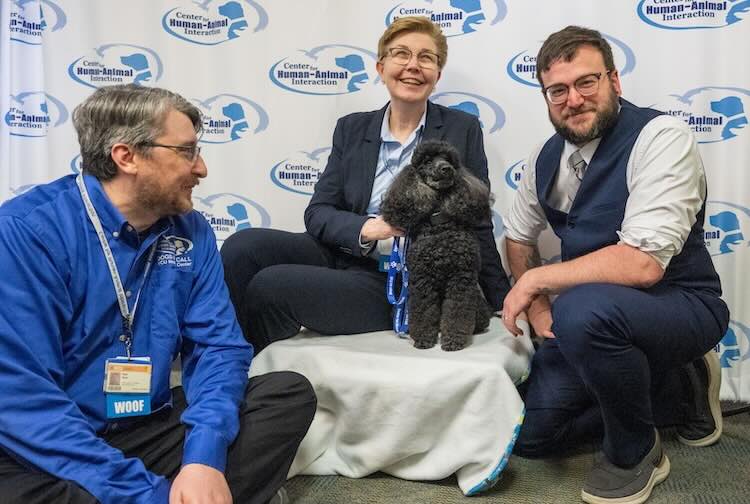 The Dogs on Call program is recognized as one of the first hospital-based therapy dog program in the United States. (Dean Hoffmeyer, Enterprise Marketing and Communications)
By Mia Stephens and Sara McCloskey-Nieves
When Lene Høeg Fuglsang-Damgaard searched for a mentor and a program to pursue her Ph.D. research, one person and one place were on the top of her list: Nancy Gee and the Center for Human-Animal Interaction (CHAI) at Virginia Commonwealth University’s School of Medicine.
Fuglsang-Damgaard was drawn by Gee’s research and wanted to learn how she could bring lessons from the center’s therapy dog program back to her home in Denmark.
“I was really interested in how the program had developed from an initial idea into the large, well-organized program it is today, especially because I would like to work towards something similar in Denmark, where dogs are currently not approved to work in hospitals” said Fuglsang-Damgaard, a former Ph.D. fellow at Aarhus University.
The program, Dogs on Call at VCU Health, is regarded one of the first hospital-based therapy dog program in the United States. Gee, director of CHAI and a professor at the VCU School of Medicine’s Department of Psychiatry, oversees the work of the volunteer therapy dog-handler teams that visit patients and healthcare workers daily at the academic health system’s locations throughout Virginia – delivering over 300,000 meaningful interactions in just the last five years.
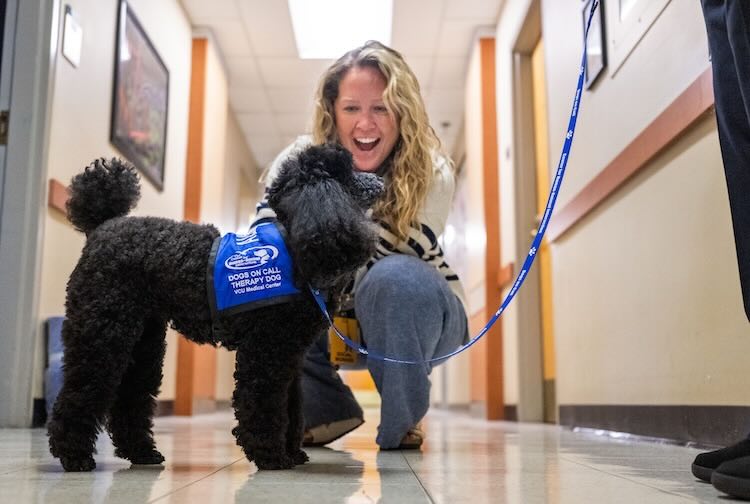 Within the last five years, the Dogs on Call program has delivered over 300,000 meaningful interactions. (Dean Hoffmeyer, Enterprise Marketing and Communications)
As a visiting Ph.D. scholar in the fall of 2023, Fuglsang-Damgaard worked alongside Gee to understand how Dogs on Call operates and to study how interactions with dogs influence people’s physical responses. Fuglsang-Damgaard knew that shadowing the dog handler teams during their shifts in the hospital could be emotional for everyone, even her.
“For many patients and their family, the visits offered a small but meaningful break from their harsh reality — a moment where the focus shifted away from illness and treatment to becoming fully present with the dog,” Fuglsang-Damgaard said. “Witnessing the power of that simple change of focus was a very special experience for me.”
Those emotions are not fleeting; they are powerful and have a lasting impact.
Over the past 25 years, CHAI has been studying how therapy dogs and companion animals can change people’s health and wellness. By building connections locally, nationally and abroad, the Richmond-based center has become a global leader in clinical research and best practices for animal-assisted services in healthcare settings.
Becoming a leading model for hospital-based therapy dogs
The Center for Human-Animal Interaction (CHAI) was established in June 2001, under the direction of Sandra Barker, Ph.D., professor emeritus of psychiatry at VCU’s School of Medicine, to provide and promote research, clinical services and education on the relationships between humans and animals.
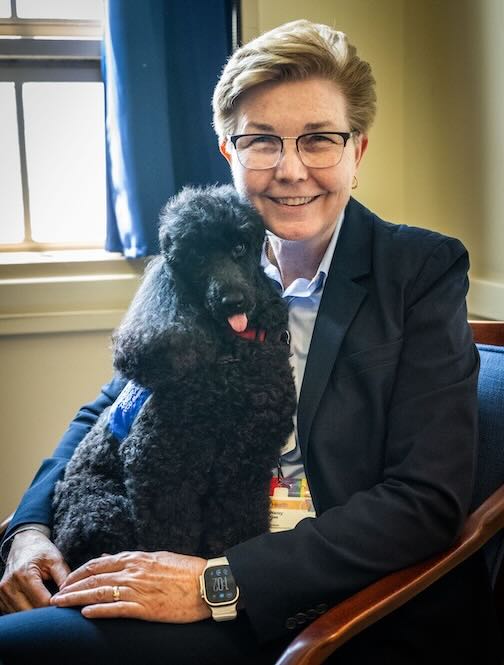 Nancy Gee, Ph.D., is the director of Center of Human-Animal Interaction. (Dean Hoffmeyer, Enterprise Marketing and Communications)
CHAI and its flagship hospital-based therapy dog program are among the first of its kind in the nation, with the center’s researchers helping to set the gold standard in the field of human-animal interaction internationally. Barker, Gee and other CHAI researchers co-authored five books and more than 200 studies. Notably, Gee said Barker “literally wrote the book on how to set up therapy dog programs, like our Dogs on Call.”
Recently, CHAI researchers published studies on therapy dogs reducing loneliness, depression and anxiety in hospitalized psychiatric patients and health benefits for older adults with pets. Gee collaborates with researchers all over the world. As of late, she worked with a team in the United Kingdom to evaluate the effectiveness of a school-based program that incorporated animal-assisted therapy for neurodivergent students.
“Working with researchers around the world has been an absolute pleasure because they bring unique perspectives to our understanding of human-animal interaction,” Gee said. “It’s interesting to see how different cultures interact with animals and how we might consider adapting news ways to achieve the best benefit for both humans and animals.”
For many patients and their family, the visits offered a small but meaningful break from their harsh reality — a moment where the focus shifted away from illness and treatment to becoming fully present with the dog.
Lene Høeg Fuglsang-Damgaard, a visiting Ph.D. scholar at the Center for Human-Animal Interaction at VCU
With research from CHAI in hand, Dogs on Call and similar programs can use the most up-to-date scientific evidence to ensure they are following best practices. For Fuglsang-Damgaard, research is crucial to justify the work of therapy dogs in the community.
“I became very aware that if we want to create the same opportunities in Denmark, the science has to be solid and evidence based,” Fuglsang-Damgaard said. “Seeing Dr. Gee’s research firsthand made it clear to me how important strong research is, and how the results can be used as a foundation when persuading healthcare professionals and decision‑makers to implement similar practices.”
Gee continues to support Fuglsang-Damgaard's research after she returned to Denmark, working with her on several of her scientific articles. They hope to collaborate on more research to better understand how dogs affect people.
“Collaborating with Dr. Gee made me realize the endless possibilities of therapy dog interventions and has motivated me to continue pursuing this much needed research,” Fuglsang-Damgaard said. “It’s inspiring to see how a well-designed study can build a strong scientific foundation to advance the field.”
(1).jpeg) While studying at VCU, Lene Høeg Fuglsang-Damgaard (right) and her family spent time with her new colleagues, including Nancy Gee, Gee’s wife, Barbara Klucik, and former VCU staff member Alex Doan, at local events such as VCU Women’s Basketball games. (Contributed photo)
While studying at VCU, Lene Høeg Fuglsang-Damgaard (right) and her family spent time with her new colleagues, including Nancy Gee, Gee’s wife, Barbara Klucik, and former VCU staff member Alex Doan, at local events such as VCU Women’s Basketball games. (Contributed photo)
Creating opportunities for therapy dog research
Not only has CHAI collaborated with partners internationally, but it has also established a strong relationship in the U.S. with the Purdue University College of Veterinary Medicine’s Center for the Human-Animal Bond, which aims to build a network with human-animal interaction (HAI) focused programs around research, education and standards within the field.
HAI programs are typically housed in veterinary schools and primarily focus on well-being of animals and responsible pet ownership. CHAI is unique in that it is based in a School of Medicine and focuses on the physical and mental health outcomes of humans. CHAI’s unique setup allows the center to do hands – on research and practice in a complex environment like the hospital – providing a rare opportunity that is not available for most students studying HAI.
“Part of the reason I believe it's so important to partner with a veterinary school is that we must also focus on the quality of life of the animals,” Gee said. “Here at CHAI and in our Dogs on Call program, the dogs are our partners in the process. It is crucial for us to advocate for their needs to help them enjoy the process of interacting with other human beings.”
.jpeg) Leanne Nieforth (left) and Nancy Gee at the Purdue Veterinary Conference in 2024. (Contributed photo)
Leanne Nieforth (left) and Nancy Gee at the Purdue Veterinary Conference in 2024. (Contributed photo)
One immediate goal of this collaboration with Purdue University is to host a joint conference to discuss gaps in research and educational objectives, connect with other centers, and bring together researchers, educators, and practitioners to learn from one another.
In the long run, Gee and her Purdue counterparts aspire to develop a coalition of centers that work together to conduct large scale research and educational opportunities. This will help to provide a space for sharing ideas and advancing the science and practice of human-animal interaction and animal-assisted services.
“By bringing together both a veterinary school and medical school approach, we have a strong opportunity to close the gap by examining both the human and animal side of the equation,” said Leanne Nieforth, Ph.D., assistant professor in Purdue Veterinary Medicine’s Department of Comparative Pathobiology. “Through this collaboration, we have a solid foundation to build and the drive and determination to make a real difference in the field of human-animal interaction.”
Throughout the years, we have been able to establish an international reputation for leadership in the field, while fulfilling our mission of improving health and well-being through human-animal interaction... I am proud of what we have accomplished and excited about what is yet to come.
Nancy Gee, Ph.D., director of the Center for Human-Animal Interaction at VCU
For CHAI and Dogs on Call, collaborating with Purdue will help identify ways to achieve the highest level of impact while maintaining safety and quality of life standards for everyone involved.
“As we gain a better understanding of the cost and benefits around human-animal interactions, we will be able to provide the most effective services for patients,” Gee said. “This will allow us to serve vulnerable populations and support the best outcome for their ongoing treatment goals.”
While there is no way to determine the number of programs that have modeled themselves after CHAI, Gee is routinely contacted to provide guidance to people all over the world – in locations such as Singapore, the United Kingdom and Australia – who want to set up their own therapy dog programs.
Over the years, the center has cultivated partnerships, advanced research and expanded Dogs on Call to VCU Health locations outside of the Richmond area, such as VCU Health Community Memorial Hospital and VCU Health Tappahannock Hospital.
For Gee, reaching the 25-year milestone represents CHAI’s on-going commitment to the field of human-animal interaction and looks forward to what the future has in store.
“Throughout the years, we have been able to establish an international reputation for leadership in the field, while fulfilling our mission of improving health and well-being through human-animal interaction,” Gee said. “For two and a half decades we have achieved our goals through consistent high-quality research, education and service. I am proud of what we have accomplished and excited about what is yet to come.”
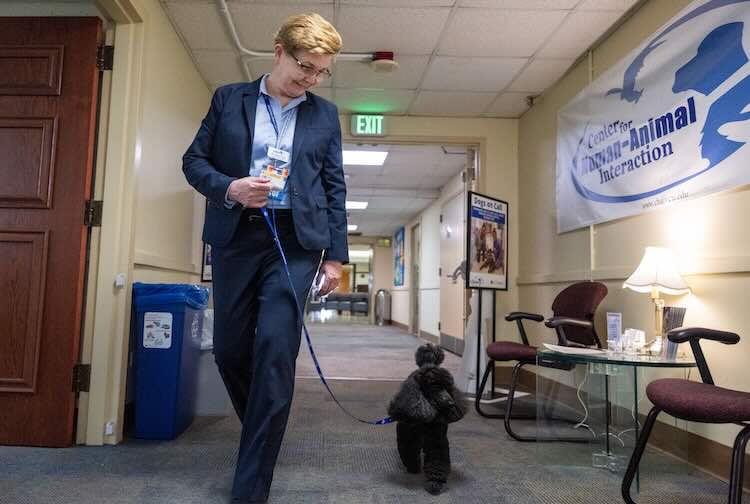 For 25 years, the Center of Human-Animal Interaction at VCU has studied how therapy dogs can influence people’s emotions and well-being. (Dean Hoffmeyer, Enterprise Marketing and Communications)