Teamwork in action: Meet the dedicated flight team serving VCU Health LifeEvac’s newest base
The emergency aviation team stationed in South Hill is ensuring rural communities have access to lifesaving care when it matters most.
February 04, 2026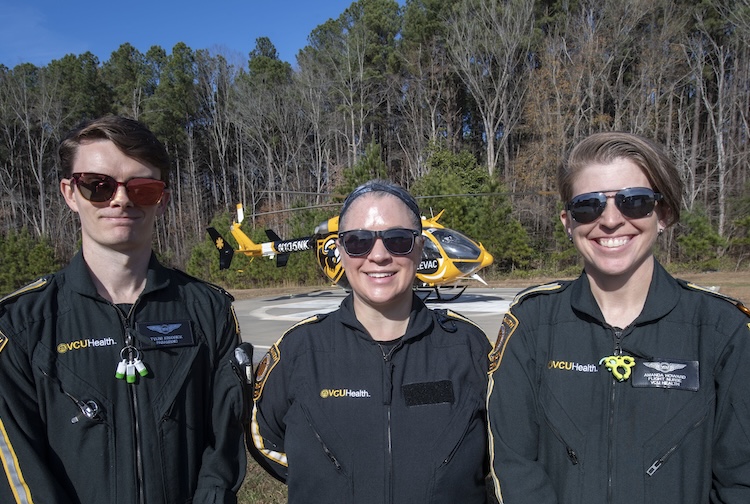 Tyler Kendrick, flight paramedic (left); Ally Griffin, flight nurse (middle); Amanda Howard, flight nurse and paramedic (right), are part VCU Health LifeEvac emergency aviation team based out of VCU Health Community Memorial Hospital in South Hill. (Allen Jones, Enterprise Marketing and Communications)
By Shea Wright
A serious medical emergency in a rural part of the state can be an all-hands-on-deck situation.
“In rural areas, you have to do the best you can with what you have,” said Ally Griffin, BSN, RN, CEN, NRP, who was an EMS provider and a nurse near her home in South Boston, Virginia. “But when you’re an hour or more away from the nearest specialty or tertiary care center with a person who needs advanced care ASAP, the reality that’s always playing in the back of your mind is that there is a community left without coverage until you return.”
Emergency medical service (EMS) providers, like Griffin, will tell you that transporting a critically injured patient by ambulance to a trauma center can take hours. This also takes life-saving resources away from those rural areas – leaving a gap in critical care for other patients in need.
Instead of taking an EMS transport unit out of the community for several hours at a time, EMS providers in Southside Virginia can now get patients to the critical care they need with a new emergency aviation base at VCU Health Community Memorial Hospital (CMH). It’s the fourth base for LifeEvac in Virginia, which opened for service in early February.
 VCU Health Community Memorial Hospital launched LifeEvac 5 in early February. It is the newest base for emergency aviation services in Southside Virginia. (Allen Jones, Enterprise Marketing and Communications)
Griffin, a newly minted flight nurse with the Southside’s LifeEvac emergency aviation, is excited to be part of the team helping change that reality.
Other dedicated VCU Health team members supporting this expansion include base supervisor Kevin Kissner, MSN, FNP-C, RN, CEN, CFRN, NRP; flight paramedic Tyler Kendrick, BS, NRP, FP-C; and flight nurse and paramedic Amanda Howard, BSN, RN, NRP, CFRN. Together, they will provide lifesaving care, on the ground and in the air, when minutes matter most.
For the emergency aviation team, no two days are ever the same.
“We spend 36 hours or more at the base each week. The base truly becomes our second home during our shifts,” said Howard, who spent more than nine years in the U.S. Air Force Reserve before becoming a civilian nurse. “From the moment we step inside, we’re ready for nearly any situation.”
Strong rural partnerships improve emergency aviation transport and patient outcomes
Despite extensive preparation, challenges are inevitable.
“The unknown is always the biggest challenge,” Kissner said, who has over two decades of experience in emergency aviation responses, including more than 10 years with VCU Health. “Fortunately, we plan for the unknowns or the ‘what ifs,’ even when a situation isn’t what you expected, preparation puts you in a much better position to respond.”
Kissner oversees daily base operations, ensuring the team has the resources and support needed to meet all medical and aviation standards. Safety is a top priority.
“Aviation safety is a major part of our work. Emergency aviation team members complete quarterly and annual safety training, maintain strict weight limits, and remain constantly situationally aware,” he said. “My role is to support the team both on the ground and in the air, so they can focus on what they do best, caring for our patients.”
Knowing that with every patient and provider interaction, I get to make a difference in someone’s life — that’s what makes this work meaningful.
Amanda Howard, BSN, RN, CEN, NRP, VCU Health LifeEvac flight nurse and paramedic
Strong partnerships with local EMS agencies and hospitals are essential when establishing an emergency aviation base in a rural community. LifeEvac works closely with local EMS agencies and other transport services during emergency responses, particularly when multiple patients are involved.
Kendrick, a paramedic who has been with VCU Health for a decade and is now approaching his first full year with the flight program, understands the importance of those relationships firsthand. Kendrick transitioned from working in an urban EMS system to a rural setting where resources were limited, and the nearest hospital was more than 45 minutes away.
“It was essentially just me and my partner responding to most of those critical emergencies,” Kendrick said. “At first, that was scary and uncertain, but it prepared me for this role. In critical situations like trauma, stroke or heart attack, timing is everything. The skills I learned back then, I get to put them to use every day.”
 VCU Health’s LifeEvac 5 flight crew is staffed by eight team members who rotate shifts throughout the week. Top row: Ally Griffith, flight nurse (left); Rionne Hahn, flight nurse; Kevin Kissner, CMH base supervisor; and Anthony Marant III, flight paramedic (right). Bottom row: Amanda Howard, flight nurse and paramedic (left); Xavier Smith, flight paramedic; Tyler Kendrick, flight paramedic; and Jamie Graff, flight nurse (right). (Allen Jones, Enterprise Marketing and Communications)
Teamwork isn’t just important, it’s essential for emergency aviation response
Teamwork is the foundation of every LifeEvac mission that guides the crew through each stage of patient care, from initial patient assessment to safe transport and handoff at the hospital.
“Patient safety starts with developing a collaborative plan of care based on the patient’s condition and anticipated clinical course,” Griffin said. “On every mission, we work together with care teams on the ground or EMS teams to double-verify every medication, name, concentration, dose, and rate, and after each mission, we debrief with our team and close any communication gaps.”
Within this collaborative environment, the work can become deeply personal for the emergency aviation team members.
“Knowing that with every patient and provider interaction, I get to make a difference in someone’s life — that’s what makes this work meaningful,” Howard said.
“I’m grateful to be a link in the patient’s chain of survival,” Kendrick added. “Whether we transport by air or by ground, I get to play a role — big or small — in helping a patient arrive safely at a facility that can provide definitive care.”
VCU Health’s LifeEvac 5 crew takes flight over VCU Health Community Memorial Hospital. (Taylor MacKillop and Will Sidaros, VCU Enterprise Marketing and Communications)
Your health matters. Sign up for updates and tips from our VCU Health care team today.