Stopping tremors in their tracks with deep brain stimulation
As pioneers of deep brain stimulation, VCU Health is helping patients better manage their symptoms from movement disorders.
September 18, 2026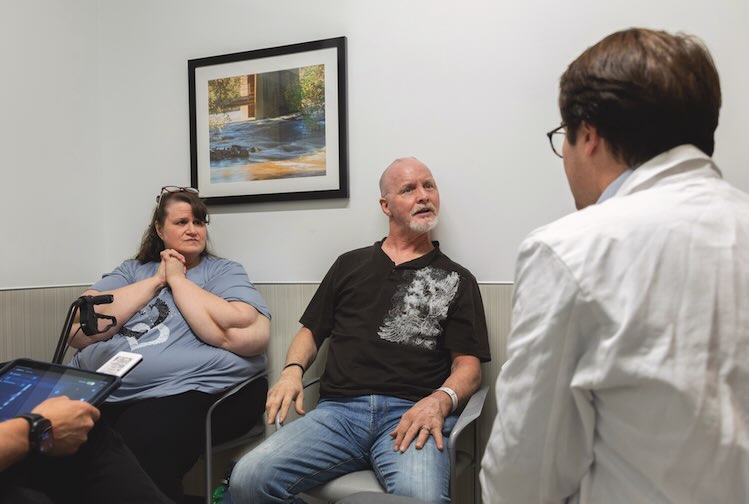 Mechanicsville residents Esther and David Lane meet with VCU Health neurosurgeon Joseph Bell IV, M.D., Ph.D., as David’s deep brain stimulation pulse generator was turned on for the first time. (Will Rummel, MCV Foundation)
By Holly Prestidge
For David Lane, living with Parkinson’s disease meant taking medications every 90 minutes to reduce his tremors. Thanks to deep brain stimulation at VCU Health, his life changed.
Esther Lane’s eyes widened. Her husband of 36 years, David Lane, sat next to her in an exam room at the VCU Health Pavilion in Short Pump this spring.
Sitting, but not still.
David, 58, was diagnosed with Parkinson’s disease in 2014.
Fresh scars traced the top of his head from his recent deep brain stimulation surgery, when surgeons implanted electrodes in the brain circuits responsible for his tremor and connected them to a pulse generator in his chest. As they sat, Alex Feria, a representative from Medtronic, the device’s manufacturer, monitored the system on a tablet before activating it for the first time.
A moment later, Feria turned on David’s pulse generator.
The change was subtle at first.
But little by little, Esther watched her husband’s body slowly relax. His jerking movements softened. His hands, usually twitching, slowly steadied and came to rest on his legs. His head was still. His clenched hands loosened their grip just a little.
She nearly cried.
The last few years have been hard. Medication initially worked for David, as it does for many people in the early stages of Parkinson’s disease.
But as the disease progressed, medication stopped working even as dosages increased.
The tremors and other symptoms of Parkinson’s interrupted every part of daily life. Bradykinesia – a symptom that causes slowness in physical actions and trouble initiating those actions – was one of the most limiting. Muscle stiffness compounded it all, making his limbs feel rigid and resistant.
At times, David said his feet felt like they were stuck to the floor, unable to propel him forward. He couldn’t make a sandwich or pour a drink because his hands shook. He had to stop driving. An insulation installation technician for many years, he stopped working in the field a few years ago. He ultimately retired in February 2025.
Before his DBS surgery, he was taking medication every 90 minutes.
David said he’d been putting off deep brain stimulation – a proven method to treat the symptoms of Parkinson’s disease, as well as essential tremor and dystonia – for as long as he could. He was scared, he said, but the results for him and his wife have been lifechanging.
“I feel better than I have in 10 or 12 years,” he said earlier this year at a follow-up appointment about two weeks after the clinic visit where his pulse generator was turned on.
Patients can adjust the settings on their device while at home and even turn it on and off. If they need help between scheduled clinic appointments, Medtronic representatives make house calls.
David said he likes to walk up and down his driveway when he’s having phone conversations. He hasn’t been able to do that in recent years, but now his neighbors are back to seeing him again – moving, talking and reconnecting with the world outside.
“I can make sandwiches without knocking them on the floor,” he said, grinning. “All those things that most people take for granted.”
It’s not perfect. He still has tremors, particularly when his medication begins to wear off. The DBS is helping to curb those fluctuations, though, it will need to be monitored for the rest of his life.
For now, one of the immediate goals is to reduce how many medications he needs. Esther joyfully acknowledged that he’s already off one, and she clapped softly when doctors talked about reducing his complex medication regimen even more.
“It’s just so amazing,” she said. Now, regular trips to Georgia to see their five grandbabies don’t seem so challenging for “Papa and Cricket,” as their grandchildren call them.
David said life before DBS was bleak.
“For a while I was feeling depressed and discouraged,” he said.
But now, his outlook has changed.
“I feel like I’m young again,” he said. “I have some hope.”
A version of this story was originally published by the MCV Foundation.
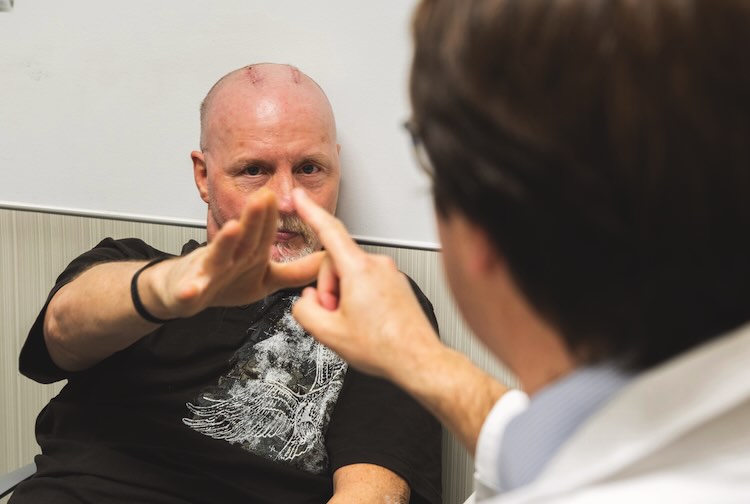 VCU Health patient David Lane was diagnosed with Parkinson’s disease in 2014. (Will Rummel, MCV Foundation)
Deep brain stimulation: How DBS works and conditions it treats
What is deep brain stimulation?
Deep brain stimulation (DBS) is a surgery that involves placing wires in a specific location in the brain and a pacemaker-like device under the skin on the chest. The device sends an electrical current to disrupt brain signals that cause abnormal movements. Even while wearing it, the DBS system can be adjusted, turned off or event removed.
What conditions does deep brain stimulation treat?
Deep brain stimulation treats several different movement disorders, including these conditions:
- Essential tremor
- Parkinson's disease
- Dystonia and Meige syndrome
- Tourette’s syndrome
- Epilepsy
Those interested in deep brain stimulation are evaluated by our neurosurgical team to see if they are the best fit for the procedure. This evaluation may include MRI and CT scans and specific examinations to better understand your movement disorder, including tests for gait, balance and speech.
What makes VCU Health’s neurosurgery team different from other hospitals?
VCU Health is a leader in deep brain stimulation; one of our neurosurgeon’s pioneering research evaluated DBS’s effectiveness in treating Parkinson’s disease. As part of an academic medical center, our team has access to groundbreaking research and clinical trials, which makes us a top choice for neurological and neurosurgical care.
Each patient’s care team includes neurosurgeons, neurologists, speech pathologists, physical and occupational therapists and more, who collaborate closely to ensure a seamless, well-coordinated experience.
VCU Health is also different from other hospitals that offer DBS because we are home to the VCU Parkinson’s and Movement Disorder Center (PMDC), which is the only center in Virginia recognized by the Parkinson's Foundation as a Center of Excellence.