Meeting the lifelong needs of adults with congenital heart disease
Amid a national shortage of experts, VCU Health Pauley Heart Center demonstrates unwavering dedication to those who grow up with one of the most common birth defects.
February 11, 2026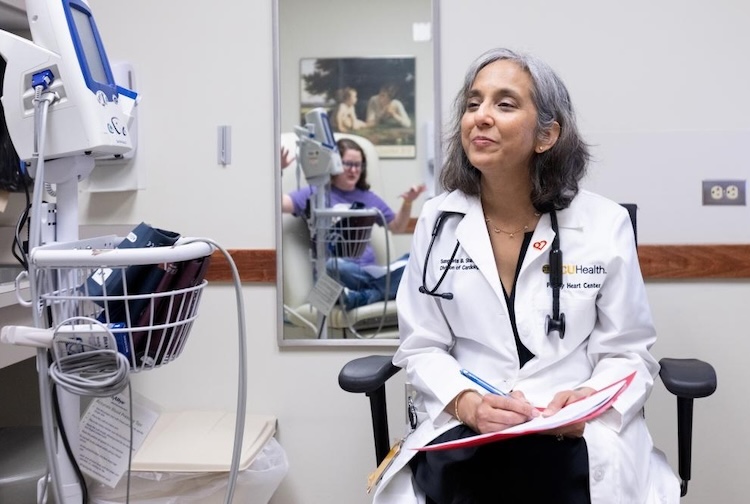 Sangeeta Shah, M.D., is the head of the ACHD program at VCU Health Pauley Heart Center. (Daniel Sangjib Min, MCV Foundation)
By Tanner Lambson and Sara McCloskey-Nieves
Congenital heart disease (CHD) – issues with the heart that are present at birth – is one of the most common birth defects. The population of people born with CHD who have entered adulthood grows by about 5% each year in the United States. At current estimates, more than 2 million Americans have the adult version of the condition, referred to as adult congenital heart disease (ACHD).
Advances in medicine have greatly improved CHD survival rates in recent decades. But ACHD patients need regular check-ups and heart imaging throughout their lifetimes to make sure their ticker is still working well. That’s because someone born with a heart defect has a higher risk of developing heart problems later in life, which may require medications, pacemakers, surgery or even a heart transplant.
As the need increases for ACHD care, the number of physicians trained to help them is not keeping up. There are less than 500 board-certified ACHD cardiologists in the U.S., according to a recent analysis.
One of those experts is VCU Health’s own Sangeeta Shah, M.D. Recognizing the need for ACHD care in Virginia, she founded and leads the ACHD Program at the VCU Health Pauley Heart Center – one of only two such programs that are well-established in Virginia.
Shah decided to join VCU Health in 2020 for a very distinct reason – the health system’s collaborative approach to care. She knew an ACHD clinic would thrive at an academic medical center like VCU Health.
“I saw that there was the capacity to create a medical home for these patients,” she said of her decision to join VCU Health. “I knew pediatric cardiology was linked to adult cardiology, and I knew that VCU could support all the testing and procedures our patients need. There was commitment from VCU Health faculty – who are at the top of their fields – to help me take care of these patients.”
ACHD care presents a unique challenge: many adults who were born with heart defects in childhood may not be aware they need long-term, specialized cardiac care in adulthood, Shah said, especially if their defect was “repaired” in childhood and they feel healthy today.
Further, “patients are loyal to and trusting of the cardiologist they grew up with, which is usually their pediatric cardiologist. The physician may not be aware of an ACHD program in their area, and if they’re not aware, they can’t refer patients to it,” Shah said.
Knowing that CHD patients need lifelong care, the Patient Empowerment Program at Children’s Hospital of Richmond at VCU (CHoR) specifically helps teenage and young adult patients and their families transition from a pediatric cardiologist to the adult heart specialists at the Pauley Heart Center. This emphasis on continuity of care from childhood to adulthood ensures that these patients are getting regular check-ups and support to prevent the development of other heart diseases.
“Our goal is to keep you living well into adulthood,” Shah said. “Your heart is different. But the way your heart looks doesn’t dictate how your life will look. We want you to know that we understand what ACHD care means for you.”
Finding solutions to fill the gaps in adult congenital heart disease care
Pauley Heart Center’s five person ACHD team — one physician (Shah), two nurse practitioners and two nurses — cares for patients five days a week at several locations, including Fredericksburg, Stony Point, and VCU Medical Center.
National maps indicate that ACHD specialists cluster around urban centers, like Richmond, leaving gaps for patients living in rural areas.
“In Virginia, our access deserts are south and west of us,” Shah said. “There are ACHD patients out there, and we can help these patients stay healthy during their adult years.”
Telehealth programs and virtual clinics offered by Pauley have narrowed the gap in Virginia, but staffing remains the limiting factor nationwide. Part of the issue behind the health care worker shortage is that there aren’t enough ACHD training programs or doctors in training to meet increasing patient demand for this cardiac specialty.
Our goal is to keep you living well into adulthood. Your heart is different. But the way your heart looks doesn’t dictate how your life will look. We want you to know that we understand what ACHD care means for you.
Sangeeta Shah, M.D., director of the VCU Health Pauley Heart Center Adult Congenital Heart Disease program
Many current ACHD physicians, including Shah, entered the field during an early “practice pathway” field that allowed physicians to train in ACHD care as part of a broader cardiology fellowship. This pathway closed in 2019. Today, the board certification process takes upwards of 12 years because physicians are required to do extra training following their cardiology fellowship post-medical school.
Potential solutions to the workforce pipeline issue that Shah suggests include embedding ACHD concentrations in general cardiology training programs, finding ways to interest medical school students in ACHD in order to develop a pipeline, and restructuring ACHD fellowships.
“With ACHD, every patient is different, and that shows in the amount of time we devote to understanding their unique nuances and solving their problems,” Shah said. “ACHD providers can get burned out because of the high complexity and the understaffing.”
The Pauley Heart Center has a history of developing training programs for cardiac specialties experiencing national shortages. In the past few years, the heart center has helped to launch a new master’s degree program in cardiac perfusion with the VCU College of Health Professions and a two-year echocardiography degree program in partnership with Rappahannock Community College. Pauley also offers 150 hours of free continuing medical education courses annually, across a variety of cardiology specialties, that are available to any interested health care worker. Shah hopes to expand training opportunities in ACHD at VCU in the coming years.
The cost of inaction is not unclear. As ACHD patients continue to age and potentially develop other chronic diseases — such as coronary artery disease, heart failure and diabetes — their health needs will become more complex and require even more specialized care.
In the meantime, grass will not grow under Shah’s feet. She will continue to advocate for more training and access to this critical service for millions of Americans.
“Invest in ACHD providers,” Shah said. “Invest in their infrastructure, and recognize it takes a village to make things happen.”
Adult congenital heart disease FAQ: Finding the right care and getting started
What is adult congenital heart disease (ACHD)?
Adult congenital heart disease refers to any heart condition a person is born (congenital heart disease) that continues into adulthood, even if the condition was treated or repaired earlier in life. These congenital heart conditions can vary from mild to complex, and many adults benefit from regular check‑ups with specialists who understand how congenital heart problems can change over time.
How is ACHD different from heart disease that develops in adulthood?
Unlike acquired heart disease — which is often a result of “wear and tear” on the heart — ACHD usually involves structural issues, like holes in the heart, or abnormal valves. ACHD is often more complex than acquired heart disease, which means a cardiologist with special training needs to treat it.
Can adults born with heart defects lead normal, active lives?
Many adults born with heart defects can and do lead fulfilling, active lives. The key is maintaining ongoing follow-up with an ACHD specialist, because the hearts of ACHD patients may still work differently, even after repairs, and may be more susceptible to other forms of heart disease.
What should I look for in an ACHD specialist?
You should look for cardiologists with training in ACHD and experience in treating patients with your specific type of heart defect. Additionally, it’s beneficial to search for a hospital or clinic with an ACHD program, like the ACHD program at the VCU Health Pauley Heart Center’s program. Since ACHD is a complex condition that can affect other parts of the body, being a patient within an ACHD program or clinic can make it easier to coordination of care between your heart team any other departments within a hospital or health system that you need to see.
What should I bring to my first visit with an ACHD specialist?
It is important that the ACHD specialist knows your medical and heart health history, so it is important to bring your medical records, particular those relating to your congenital heart disease, if you have them, which may include: childhood records, surgery notes, a list of your current medications and your family’s medical history (if you know it).
If you are transitioning from pediatric CHD care, your pediatric cardiologist should be able to provide you with this information. At VCU Health, you can upload most of this information to your MyChart account, so it’s easily accessible to your care team.
If you are currently the parent of a CHD patient at Children’s Hospital of Richmond at VCU, there is a program called the Patient Empowerment Program which offers a dedicated team that can help your family transition from the pediatric cardiology team to the adult side. Ask your CHoR providers about enrollment.
Stay informed, stay healthy. Sign up for VCU Health’s e-mail newsletter.