Healing trauma, inside and outside the hospital walls
VCU Health’s Injury and Violence Prevention Program is helping create safer communities through education, outreach and evidence-based interventions.
August 10, 2026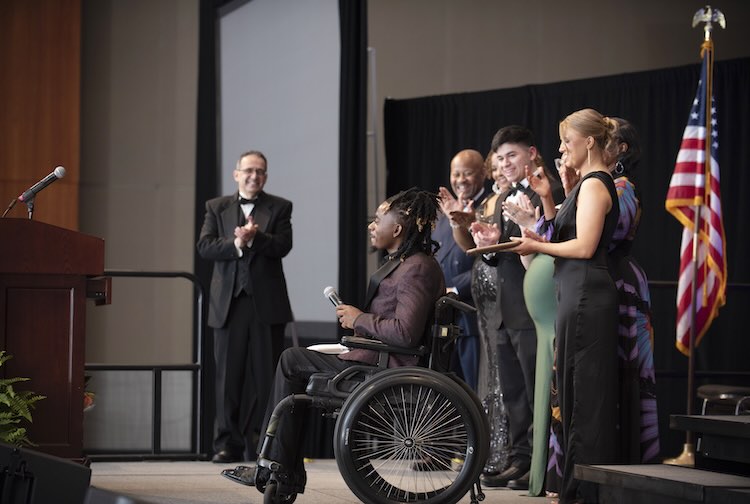 Darrell Anderson was shot five times in September 2020. He is now a Bridging the Gap peer support specialist and was honored at the 2024 Shining Knight Gala for his work helping others rebuild their lives. (Duane Berger Photography)
By Amanda Kowaleski
As the medical director of the only comprehensive Level I trauma center in the region, Michel Aboutanos, M.D., believes hospitals should play a key part in reducing life-altering injuries and violence, not just treat those impacted by them.
“Here at VCU Health, we’ve had a paradigm shift of what the role of the trauma center is,” said Aboutanos, professor of surgery and chair of the Division of Acute Care Surgical Services at Virginia Commonwealth University. “We’re part of the community instead of just being on the receiving end of the effects of violence and high-risk behaviors.”
Through donor and grant support, VCU Health’s Injury and Violence Prevention Program applies proven methods to promote safety and wellness.
Breaking the cycle of violence with hospital-based interventions
While Aboutanos remains proud of the high level of clinical care the multidisciplinary trauma team provides, he knows they face a troubling trend when it comes to victims of violence.
“We’d take care of the patient and send them back out into the community, only to have them come right back with another gunshot wound, another stab wound. It’s a vicious cycle.”
That’s why in 2003, he helped launch Bridging the Gap, a hospital-based community violence intervention program. Early in their hospital stay, patients are offered intensive case management services such as housing assistance, enrollment in educational and vocational programs, connection to positive social outlets and access to mental health services. and access to mental health services.
It often takes multiple conversations with patients before they commit to the program, but Aboutanos says the extra effort is worth it.
“We gain their trust. In the hospital, they are in a state where they are far more likely to listen and change,” Aboutanos said. “We tell them, ‘I am here for you. Whatever you’ve been involved with, let’s talk about it. If you trust me enough to care for you, to operate on you, to help you heal, can you trust me to connect you with a team and with resources that can and will help you?’”
Between 200 and 300 people benefit from the Bridging the Gap program each year, and it has become a national model for healthcare centers across the country. Researchers found Bridging the Gap participants were nearly 70% less likely to return with another injury from violence than patients who declined to participate, with some patients coming back to serve as case managers.
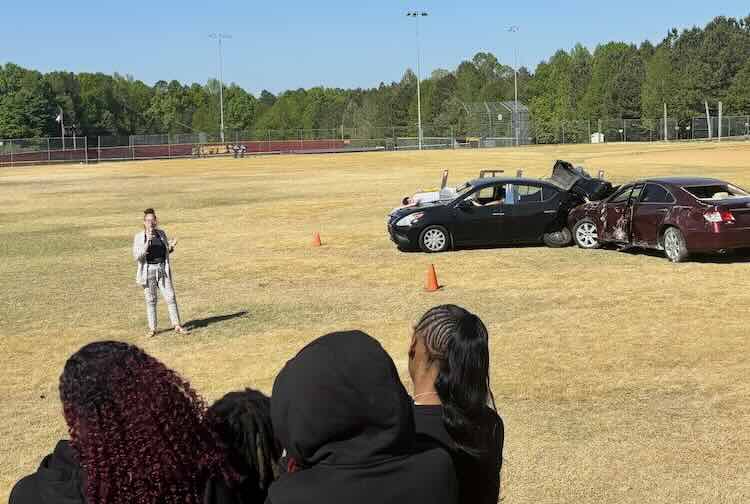 Tiara Braxton, LMPH-R, QMHP-A, with VCU Health’s Project IMPACT, recently spoke with students at Nottoway County High School about the importance of making safe decisions behind the wheel. (Shea Wright, Enterprise Marketing and Communications)
Reducing high-risk behaviors in youth with community partnerships
While every death can take its toll on healthcare providers, losing a young patient can shake even seasoned physicians like Aboutanos.
“It is devastating to walk up to a mom and tell her, ‘I’m sorry, your child did not make it,’” Aboutanos said. “That scream — it just doesn’t leave you. So in our trauma center, we want to prevent the very injuries that we see and the suffering that we witness daily.”
Enter Project IMPACT. The program — Impacting Minors Perceptions and Attitudes Concerning Trauma — focuses on student-targeted injury and violence prevention by providing education and awareness about the realities of trauma. Funded by a grant from the Virginia Department of Motor Vehicles, a multidisciplinary VCU Health team partners with local first responders to visit local high schools and present information about high-risk behaviors and how injuries and deaths can be prevented. Students also participate in simulations and mock scenarios, such as a deadly car crash caused by distracted driving.
“Just telling teenagers doesn’t work,” Aboutanos said, who holds the Rao Ivatury, M.D., Professorship. “With Project IMPACT, they see the person who died being put in a body bag. They see the reaction of their simulated parents. They see what we do in the field and in the hospital to try to save someone.”
Project IMPACT began in 2012 and now reaches between 5,000 and 6,000 students per year in nearly two dozen school districts. The program expanded this spring to Southside Virginia, partnering with VCU Health Community Memorial Hospital team members to put on a simulation for students from Nottoway County High School.
After these educational events, some students even reach out to shadow healthcare professionals and first responders.
“No death is going to be in vain. It is my hope that we use those stories to help somebody else,” Aboutanos said. “People who invest in these programs can be assured through our research that they work, and that makes a big difference.”
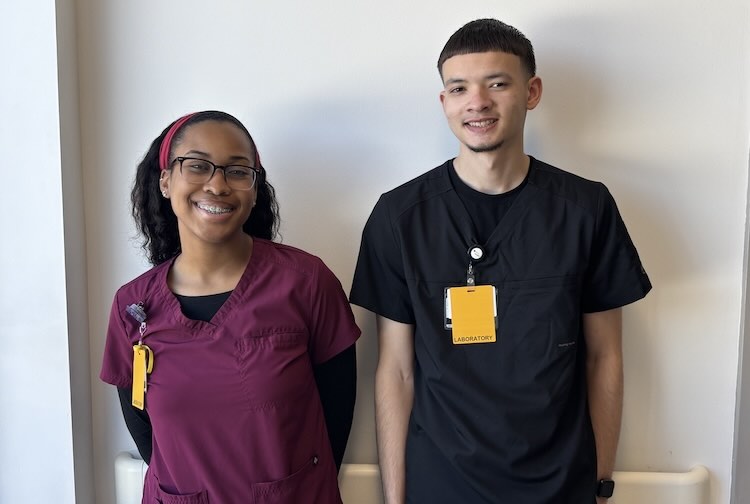
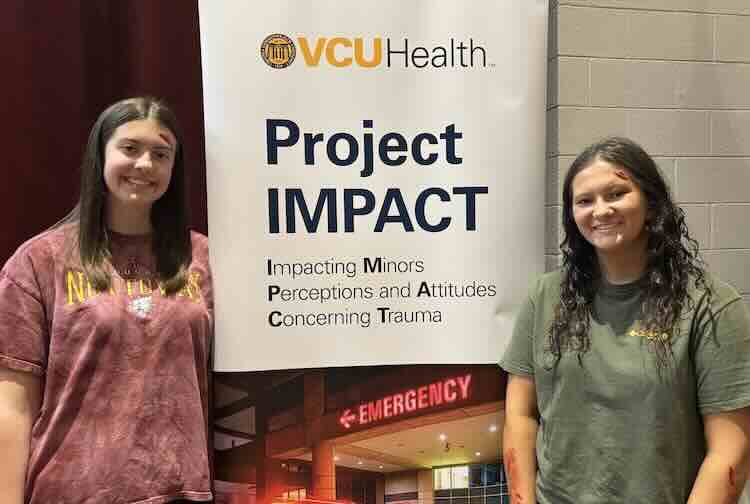 Nottoway County High School seniors Makenzie Paulett (left) and Avery Cliborne (right), who participated as crash victims, say Project IMPACT was an important learning experience that will stick with them years after graduation. (Shea Wright, Enterprise Marketing and Communications)
Stay informed, stay healthy. Sign up for VCU Health’s e-mail newsletter.