Elementary school principal’s life is saved by collaborative teamwork of Richmond medical community
The unwavering dedication of VCU Medical Center's trauma care team helped Greg Muzik recover after a devastating cyclist v. vehicle crash.
May 18, 2026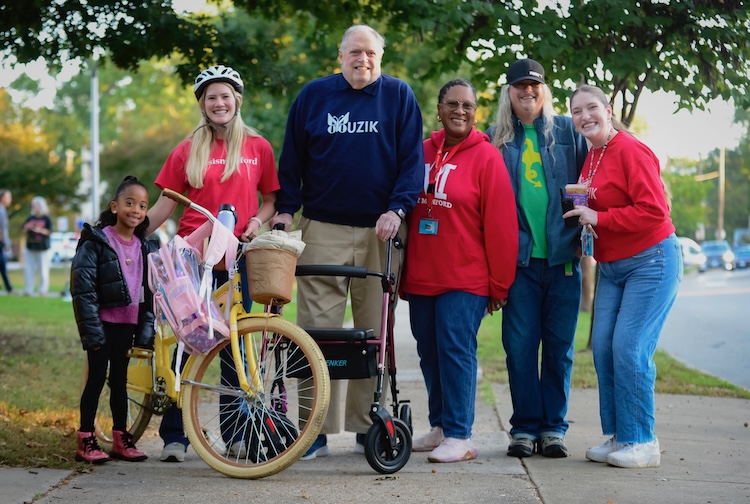 Greg Muzik, principal of Mary Munford Elementary School in Richmond, Virginia, sustained major injuries after he was hit on his bike by a vehicle. He was cared for at VCU Medical Center – the region's only comprehensive Level I trauma center – and Sheltering Arms Institute. (Contributed photo)
By Leigh Farmer
Nothing slows down 77-year-old Mary Munford Elementary School principal Greg Muzik. The only brakes the principal touches are the ones on his bike, which he rides to school as often as he can.
His reputation as a loving and energetic principal has preceded him for years. His daughter Logan, also a teacher, is proud to say she followed in his footsteps.
“The Munford community just loves him! They take care of him,” Logan said.
But everything suddenly stopped on the evening of March 11, 2025. A car going at an estimated 55 miles per hour hit Greg as he biked his route home from school. The news got to Logan fast.
Greg was already in an ambulance, headed to VCU Medical Center – the region's only comprehensive Level I trauma center – from the scene of the accident.
Logan was left looking at the remnants of a crash that, to her, had only one clear conclusion: “Nobody could survive that.”
“I saw the bike, and I was terrified and all I wanted to do was get to the hospital,” she added. “There are only two reasons he's alive. One is that he was wearing a helmet, and two is that they took him to VCU.”
At VCU Health's Shining Knight Gala, Greg Muzik’s trauma care team was honored for their dedication to his care. (Jake Burns, Taylor MacKillop, Robin McLeod and Will Sidaros, Enterprise Marketing and Communications)
On the scene: Lifesaving care begins with first responders
Moments before Logan arrived, first responders from the Richmond Fire and Emergency Services and Richmond Ambulance Authority were doing everything they could to give Greg a window of hope to make it to the hospital.
“This is by far one of the most traumatic – if not the most traumatic – bicyclist versus vehicle accidents that I've ever been a part of,” said Capt. Chris Armstrong of Richmond Fire and Emergency Services.
First on the scene, Armstrong and his team began to address the injuries – prepping Greg to be transported to VCU Medical Center as soon as the ambulance arrived.
One of his fingers was almost completely detached. His leg was broken and bleeding. They wrapped it all with gauze.
But the most immediate need was oxygen. Greg’s ribs were crushed and one of his lungs collapsed.
“He kept grabbing me and he was saying ‘I can't breathe.’ We needed to move on to more advanced maneuvers,” recalled Ta’Shawn Arrington, a paramedic with the Richmond Ambulance Authority.
These advanced lifesaving techniques were crucial to Greg’s survival. Two teams of emergency responders – working together – are credited with giving him a fighting chance when he arrived at the VCU Medical Center.
Precision under pressure: The role of a Level I trauma center
“When a patient arrives at the resuscitation room, there's choreography that immediately happens. Nobody needs to say anything,” said Harinder Dhindsa, M.D., MPH, MBA, director of the division of emergency medical services at VCU Medical Center.
He and a whole trauma care team met Greg as soon as the ambulance arrived at VCU Medical Center. Greg was alive but still struggling to breathe.
“Anytime a patient is hit by a car, either on their bike or walking, I've kind of learned to assume that they're sicker than they sound,” said Natalie Wall, M.D., chief resident of trauma. She performed emergency surgery on Greg when he arrived at VCU.
Underneath the cuts, bone breaks and scrapes, doctors soon discovered much more serious injuries.
“Part of our training is you don't let the extremity injuries distract you because those typically are not going to be life-threatening, at least not immediately life-threatening,” Dhindsa said.
Greg had internal bleeding, and they had to find the source.
“We were more focused on his chest and his abdomen and his pelvis, which is really where the time-sensitive hemorrhage can occur,” Dhindsa recalled.
I would not have my dad if it hadn't been for the doctors, the nurses, the respiratory therapists, the surgeons and the physical therapists because he could have died.
Logan Muzik, Greg's daughter
The team decided to intubate and sedate him quickly so they could get him back to the operating room. Before Greg went to sleep, Dhindsa tried to provide him with assurance that he was in good hands.
Greg was scared, badly hurt, and in and out of consciousness. But he had something in common with every clinician he was surrounded by – his reputation preceded him.
“I said ‘Hey, word on the street is you're a principal in our community,’” Dhindsa recalled. “And he kind of opened his eyes and smiled and I said, ‘We're going to take great care of you. I promise you’.”
After that, Greg was taken to surgery – the first of many.
When a person is run over by a vehicle, injuries often reveal themselves over time. And in Greg’s case, that’s exactly what happened. “He had injuries to pretty much every organ system that you can have injuries to. He had orthopedic injuries to almost every limb. He had injuries in his abdomen,” said Katie Nealon, M.D., a trauma surgeon.
The beloved principal spent weeks in critical condition. A pre-existing heart condition added another layer of complexity to his injuries. But as Dhindsa promised, Greg’s care team never left his side.
The heartbeat of a Richmond elementary school
Greg is the epicenter of Mary Munford Elementary School in Richmond. Cards, drawings, flowers and balloons covered his room during the six weeks he was in the hospital – evidence of a large community supporting and praying from afar.
“Mr. Muzik has probably the most involved community that I've ever seen,” Nealon said.
His family is tightly knit, too.
“When I thought he might not survive, I was really scared because I couldn't picture what my life looks like without him there,” Logan said.
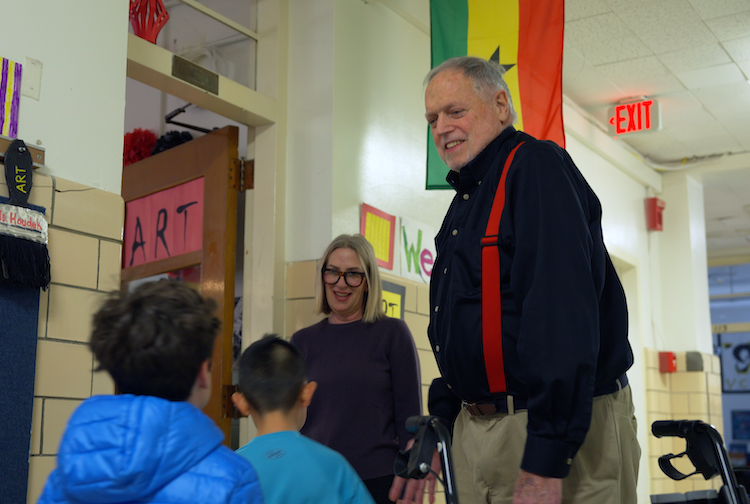 VCU Health patient Greg Muzik was determined to gain the strength to get back to his family and Mary Munford Elementary School community. (Jake Burns, Enterprise Marketing and Communications)
While at VCU Medical Center, Greg’s community grew even larger.
“When you see someone go from a patient to a person, it totally changes how you think of them in your mind. It reminds you why you do what you do,” said Nealon, who was by Greg’s side for his 32 days in the surgical trauma intensive care unit (ICU).
“I remember going into his room for the first time and seeing cards all over his room. It was really cool,” said Taylor Calabrese, R.N., nurse in the surgical trauma ICU.
She recalled spending time with Greg on a rare day when he was her only patient.
“I spent probably three hours in his room just shaving his beard and combing his hair, washing his hair, and bathing him from head to toe. I gave him all fresh sheets, a fresh gown,” Calabrese said. “And then that was the same day we got into the chair for the very first time, so it was a really, really exciting day for him, and you could tell that he was grateful.”
Greg went from being the caretaker to needing the care. And each person who had the privilege of caring for him was honored to do so.
Regaining strength after traumatic injuries specialized rehabilitation
Logan can describe her dad in five words: “Funny, kind, helpful, loving and determined.”
Each adjective has been a source of power for Greg at some point in his life. But, according to his VCU Health care team, determination is his superpower. It helped to save his life.
“If I were to put a percentage on him merely surviving the hospital at all, I’d probably put it around 5%,” said Craig Sadler, M.D., a trauma surgeon who also performed life-saving surgery on Greg when he was first brought to VCU.
And the determination of the care team surrounding Greg was just as strong. Everyone was cheering him on. He spent ten days in a step-down unit at VCU Medical Center before transferring to Sheltering Arms Institute, a state-of-the-art rehabilitation facility in collaboration with VCU Health that would help him learn to get back on his feet.
“You notice a lot of patients, they can get really down. They can be really upset because their life has just kind of been turned upside down,” said Maeve Walker, a patient care technician. “But with him, he was just always focused on what's the next thing and how to be better about it.”
The story of his accident – covered extensively by local news outlets – was well known to Greg’s rehabilitation team. The doctors and therapists were amazed at how far he had come.
“For all intents and purposes, Greg Muzik should not be with us right now,” said Jessica Hupe, M.D., a physical medicine and rehabilitation physician with VCU Health and Sheltering Arms.
But he was determined to work hard in rehabilitation to meet one true goal – to get back to Mary Munford and his family.
“I've known Mr. Muzik for a very long time. He was the principal at my children's school,” said Julie Seabury, P.T., C.H.T., hand therapist at VCU Medical Center. “He saw my badge and he said, ‘Seabury... Amelia and Alex!’ He knew my kids' names, which was just incredible after everything he'd been through.”
You notice a lot of patients, they can get really down. They can be really upset because their life has just kind of been turned upside down. But with [Mr. Muzik], he was just always focused on what's the next thing...
Maeve Walker, VCU Health patient care technician
It took about two weeks for Greg to stand up once he got to Sheltering Arms. Healing takes time. The required three hours of physical and occupational therapy was painful and challenging. But it was no match for Greg.
Sheltering Arms physical therapist Amanda Lyons recalls hearing his goal for the first time: “We were talking about fifth grade graduation coming up and he said, ‘Oh, I really want to be able to go to that. I don't think I'm going to be able to. I really want to.’”
Greg made it to graduation thanks to Lyons and the rest of the team at Sheltering Arms.
“Probably the highlight of my career to be honest,” Lyons said. “To see just his whole community, his faculty, the kids in the front, the fifth graders in the front crying to see him because they were so happy. They hadn't really heard of how he was doing. No one had really seen him until he walked on that stage, so just his ability to walk said it all.”
Reflecting on the care that made Greg Muzik’s recovery possible
As every medical professional reflects on the crash that brought Greg to VCU Health, there is one clear consensus – Greg beat the odds.
The quick work of first responders and VCU Medical Center's trauma care team, along with the continuous vigilance of clinical care teams and Sheltering Arms, all ensured a continuation of care that left no room for failure.
“It's amazing when we as a team, as a health system, are able to restore health to somebody like him, to anybody, but certainly somebody like him,” Dhindsa said. “He is such a heavy contributor to the community... What a great thing to be able to return him to his family, to the community.”
Logan is grateful, too.
“They're the reason I still have my dad,” she said. “I would not have my dad if it hadn't been for the doctors, the nurses, the respiratory therapists, the surgeons and the physical therapists because he could have died.”
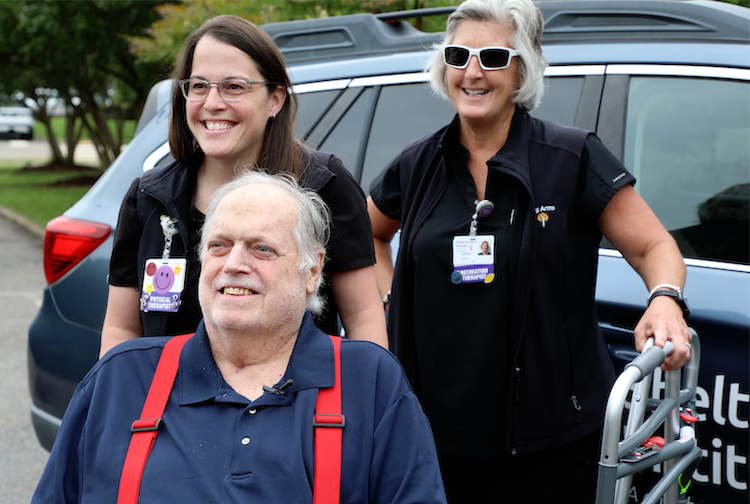 Greg Muzik’s trauma care team was honored at the Shining Knight Gala for their perseverance and dedication to his care. (Sheltering Arms Institute)
Honoring those who save lives in Central Virginia
Each year, VCU Health’s Shining Knight Gala honors the emergency responders and clinicians who saved the life of a patient facing complex traumatic injuries.
This year’s Shining Knight Gala took place on May 16, 2026, and honored Greg’s trauma care team for their perseverance and dedication to his care. The gala raises money for VCU Health’s Injury and Violence Prevention Program and recognizes those who protect and save lives in the Richmond region.
Relied on regionally and respected internationally, learn about VCU Health’s Level I trauma center.