A brother's liver donation gives his sister a new lease on life
A living donor transplant at VCU Health Hume-Lee Transplant Center freed Stephanie Johnson from a rare liver disease and robotic surgery quickly got her brother back to his life in California.
October 21, 2026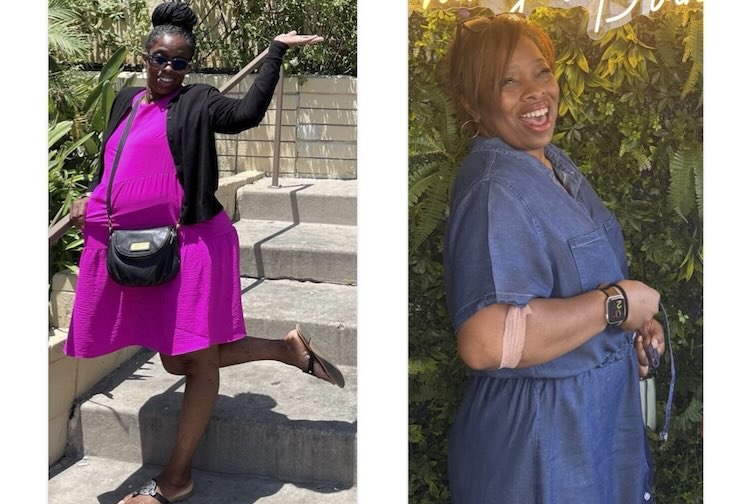 Before her operation, Stephanie Johnson (left) was always asked when her baby was due. However, the baby was actually a cyst on her liver. After the cyst was removed and she received a liver transplant, Stephanie says she has a new lease on life (right). (Contributed photos)
By John Battiston
Strangers used to ask Stephanie Johnson when her baby was due.
Stephanie wasn't pregnant. She had polycystic liver disease, a rare inherited condition that fills the liver with cysts until the organ crowds everything around it. Hers had grown large enough that she draped her middle in scarves and bought T-shirts three sizes too big.
"I used to get mad about it, then I stopped, because I did look pregnant," said Stephanie, a resident of Virginia Beach.
The disease cost her more than her confidence. Stairs left her winded. Travel wore her out. She ate small portions because the cysts pressed against her stomach and made her feel full when she wasn't. And she itched constantly — her ears, her wrists, her arms, her legs — badly enough that she scratched until she had open wounds.
Most people with polycystic liver disease never need a transplant. In a small group of patients including Stephanie, the cysts keep growing until the liver stops being an organ with cysts in it and becomes a mechanical burden inside the abdomen. It compresses the stomach, lungs, diaphragm, blood vessels and kidneys.
"Think about holding two soccer balls inside your belly, for a long time," said Seung Duk Lee, M.D., Ph.D., surgical director of liver transplant at VCU Health Hume-Lee Transplant Center. "It's a very tough situation."
A transplant wait list or living organ donation
For a time, Stephanie found relief in interventional radiology procedures that drained the cysts crowding her diaphragm. However, after suffering damage to her liver and kidneys in September 2025, her care team added her name to the liver transplant waiting list.
Getting listed, though, is just the first step in a potentially drawn-out process. According to the Organ Procurement and Transplantation Network (OPTN), over 9,000 U.S. patients are waiting for a liver at a given moment. Making matters worse for Stephanie, polycystic liver disease can be miserable to live with long before it registers as critical in the scoring system that decides who gets called first.
"The liver gets so big in the patient’s belly, and it causes a lot of pain," said Teresa Crenshaw, a living donor coordinator at VCU Health Hume-Lee Transplant Center. "They may not know when they’re going to get a call for a transplant, so a living donor is a way to get there.”
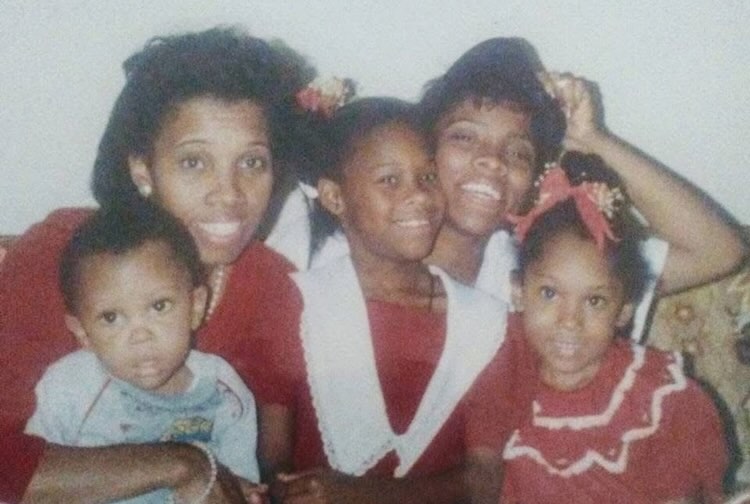 Stephanie (back) and Marcus (left) with their mom, Ronda, and sisters, Tiffany and ReVae, when they were younger. (Contributed photo)
Stephanie had already decided she would never ask her family to be a living donor for her. Other people on the list, she reasoned, needed a liver more than she did.
Her brother didn't wait to be asked. Marcus Brown — Stephanie’s youngest sibling, single and, by his own description, carefree, working as a DJ in California — raised the possibility with their mother first. Waiting for a stranger to step forward made no sense to him when he was standing right there.
"Family is one of the most important things in this world," Marcus said. "It was my time to step up and step in."
Stephanie heard about his interest secondhand, through their mother, and it stopped her cold.
"I was shocked that he would be willing to do that," she said. "I probably would still be on the list if it wasn't for my brother.”
Parallel procedures
Living donor liver transplantation isn't offered at every transplant center. Nationally ranked among the top five programs for living donor liver transplantation, Hume-Lee has invested heavily in advanced technology, research and surgical expertise. Those capabilities draw patients from across the nation for care and help identify more living donors for transplant patients in need. In Marcus' case, that meant he was able to donate to his sister despite living across the country in California.
The living donor team at Hume-Lee built Marcus' evaluation around his West Coast schedule, creating a streamlined process that minimized travel without compromising his safety. They followed the standard approach for out-of-state donors: education by phone, labs drawn locally, a telehealth visit with the surgeon, then a single trip east for scans, heart studies, a CT and an MRI, and to meet the team in person.
Living donation relies on the liver's rare ability to regenerate to nearly its full size and on two surgical teams working simultaneously in adjacent operating rooms through a dual procedure that can run 10 to 12 hours. Hume-Lee's experience with these highly specialized cases allows the program to care for both local and out-of-state patients.
The operations were in late February 2026. Marcus’ donor procedure was performed by Lee, using robotic assistance. Removing part of a living donor's liver once required a long abdominal incision. Today, it can be done through much smaller ones, which eases pain, shortens the typical hospital stay to four to seven days and leaves far less scarring behind.
"Robotics is not the goal by itself," Lee said. "The goal is to give a healthy donor the safest operation we can, with less surgical trauma, while maintaining the precision required for a complex liver operation."
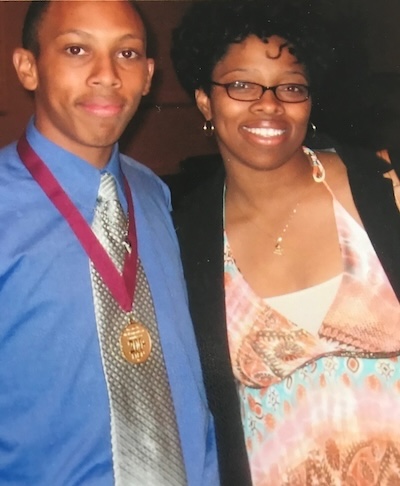 Stephanie and Marcus have been there for each other during some of the most meaningful moments in their lives, including an event where Marcus was recognized for his academic achievements in high school. (Contributed photo)
On the recipient side, the greatest challenge was the organ itself. Stephanie's cystic liver had grown to roughly six times the normal size, large enough to reach down toward her pelvis. It was also stiff. The operation called for peeling the liver away from the major vein running through the abdomen, a tricky procedure in this case given the liver’s size.
"I've participated in liver transplants over a thousand times, and this was a difficult case for anyone of any experience," said David Bruno, M.D., FACS, director of Hume-Lee Transplant Center. "There was no margin for error."
Bruno and his team removed Stephanie's entire diseased liver, cysts and all, and implanted the segment from Marcus in the same operation — a highly coordinated effort.
"We operate as a team," Bruno said. "I did this hepatectomy with a partner with tons of experience. Those are the ways you're successful with these cases."
Recovery from transplant surgery one step at a time
Marcus’ recovery surprised him: It hurt less than he expected and drained his energy more. He stayed in Richmond for about three weeks, long enough for the living donor team — which follows every donor for two years — to make sure his liver was regenerating by CT scan before he flew home.
He set the pace himself, taking hospital stairs instead of the elevator because he had stairs waiting at home. Even after returning to California, he still needed a couple of weeks to return to the long walks and jogs he always enjoyed.
Stephanie's road was even longer. Roughly a month after the transplant, while imaging her abdomen to rule out an infection near the transplant site, her team found a slow-growing cancerous growth in her colon.
While her autoimmune system was still weak and adapting to the new organ, Stephanie’s Hume-Lee care team worked seamlessly with their parters at VCU Massey Comprehensive Cancer Center to ensure the cancer was safely removed.
It came out in a second operation conducted by Leopoldo Fernandez, M.D., a surgical oncologist at Massey, on March 20. After an additional stay, Stephanie left the hospital on April 9, more than six weeks after the transplant surgery.
"I would have just been closed up and it would have turned into cancer," she said. "I will always sing the praises of VCU."
Then came her own flight of stairs.
"I was running up the steps one day, and I thought, ‘Oh my gosh, I can run up the steps,’" she said. "I am in such a different space than I was before. Overall, I am so thankful to God, my brother and VCU for improving my health and taking such good care of me."
'The gift of life is worth giving'
Seven months out, Stephanie has retired after 30 years working in mental health and is spending the energy she got back on her two sons. She finishes her meals now. She buys shirts in her own size — a seemingly small thing, she says, that is a big deal. Marcus is working out and DJing again.
Bruno says Stephanie’s turnaround is the whole argument for living donation: "It's an extraordinary change in her quality of life, from almost having no quality of life. To restore that through a living donation, that gift from her brother, is really beautiful."
What sits with Stephanie is what her brother gave up to get her here. She was at a doctor's appointment when the weight of it caught up with her, and she texted Marcus rather than call, because she knew she couldn't hold her voice together.
"At no point do I ever want him to feel that I took his gift for granted," she said. "It was just a lot to give."
His texted reply: "You have me crying this morning."
Marcus has simple advice for anyone weighing the decision to be a living donor.
"Just do it," he said. "The gift of life is worth giving."
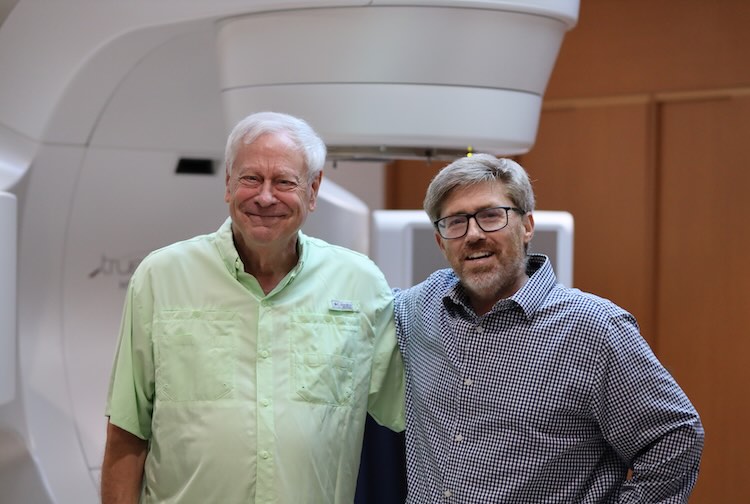
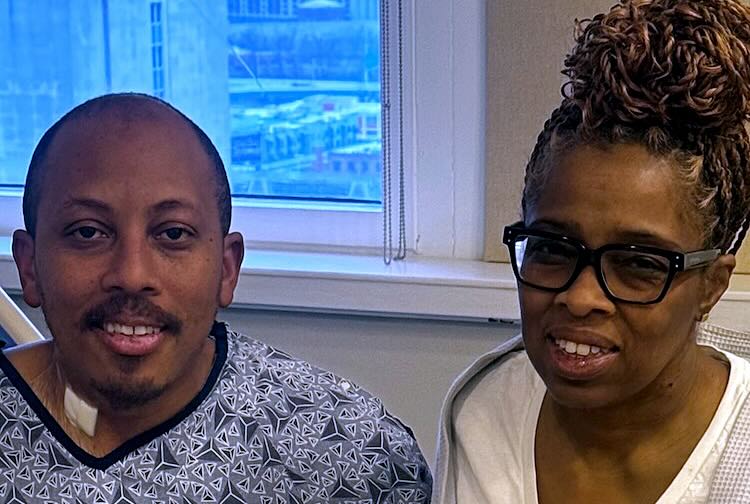 Marcus Brown (left) donated part of his liver to his sister Stephanie Johnson (right), who lived with polycystic liver disease for many years. (Contributed photo)
How to become a living liver donor
Can anyone donate a liver?
To become a living liver donor at VCU Health Hume-Lee Transplant Center, you must be between 18 and 59 years old and in good overall physical and mental health. Potential donors will go through extensive medical and psychological testing with a transplant team to make sure the donation is safe for both the donor and recipient.
Living liver donors can be family members, friends, coworkers or even people who decide to donate their organs altruistically to someone they don’t know. The decision to donate must always be voluntary.
What health conditions disqualify you from donating a liver?
Certain medical conditions may prevent someone from becoming a living liver donor, including significant liver disease, uncontrolled diabetes, serious heart or lung disease, active cancer, and certain blood clotting disorders. Pregnancy is also a reason to postpone donation.
Overall, living organ donors need to be in generally good health to ensure they can safely donate. The transplant team carefully assesses every potential donor to ensure the highest level of safety for both the donor and recipient.
What is the recovery time after liver donation?
At VCU Health Hume-Lee Transplant Center, living liver donors typically stay in the hospital for 4 to 7 days following surgery. Many donors can return to work and resume normal daily activities within 4 to 6 weeks, though it may take longer for them to fully recover and return to more strenuous activities.
Most living donor surgeries are performed using minimally invasive, robotic techniques at Hume-Lee Transplant Center. This type of surgery uses smaller incisions and is less painful for the patient after the operation, so the recovery time is typically faster compared with traditional open surgery.
How has robotic surgery made it easier to become a living organ donor?
Robotic surgery has removed many of the barriers that once discouraged people from becoming living organ donors.
Compared to traditional open surgery, robotic techniques use smaller incisions, which causes less scaring and pain after the operation. The donor’s hospital stay is usually shorter, and their recovery time is faster too.
While living liver donation is still a major surgery, advancements in robotic techniques can make the experience less physically demanding and help donors return to their everyday livers sooner.
Why should I consider becoming a living organ donor?
Living organ donations can make an extraordinary impact on someone’s life.
Patients who are sick and need a transplant may sit on a national waitlist for years before they are contacted about a potential deceased donor. Living donor transplant can significantly reduce that waiting period, allowing patients to receive a transplant before their condition gets worse. Also, living donor transplants can often give patients outcomes that are as good as or better than those from deceased donor transplants.
Becoming a living organ donor also has a broader impact. Every patient who receives a living donor organ is removed from the national transplant waiting list, helping increase opportunities for other patients who are still waiting for a lifesaving transplant.
Most importantly, living liver donation is a deeply personal decision that should be made voluntarily, with a full understanding of the benefits and potential risks.