VCU-led study will dispatch drones with AEDs for 911 calls in James City County
In collaboration with Duke Health, the project is the first of its kind in the United States to test drone first responder systems for treating cardiac arrest.
August 05, 2026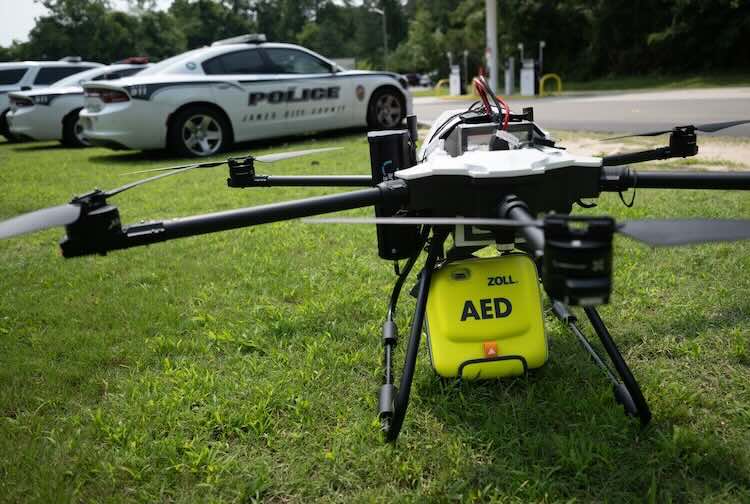 This research initiative will assess whether first responders can move the needle on emergency response times by delivering an AED to the scene of a cardiac arrest by drone. (Dean Hoffmeyer, Enterprise Marketing and Communications)
By Olivia Trani
When a person’s heart stops, every minute matters for survival. A new study involving Virginia Commonwealth University and James City County will assess whether drones can help deliver lifesaving care faster.
VCU researchers have partnered with James City County’s public safety agencies to dispatch drones carrying automated external defibrillators (AEDs) to patients during real 911 calls for cardiac arrest. The effort is part of a first-of-its-kind study in the United States, led by Duke Health and VCU, to demonstrate whether drones can improve cardiac arrest outcomes in rural communities.
“This study has the potential to break barriers in ways that we previously hadn’t imagined would be possible,” said Joseph P. Ornato, M.D., a VCU Health emergency medicine attending physician, professor in VCU School of Medicine’s Department of Emergency Medicine and co-principal investigator of the study. “If we can deliver AEDs to patients even a few minutes faster, we could potentially save tens of thousands more lives nationally each year.”
In the United States, more than 350,000 people suffer from cardiac arrest outside of the hospital each year, and fewer than 10% survive. If an AED can be used in the first few minutes of a cardiac arrest, survival rates can increase dramatically. But over 80% of these emergencies occur in a home, and EMS often takes 8 to 10 minutes to arrive at the scene, and then more time passes before they can deliver care.
“The clock is really the problem – every minute that goes by after a cardiac arrest drops the odds of survival by 10%,” Ornato said. “Despite the progress we’ve made in cardiac resuscitation, we still lose a third of a million Americans each year because we can’t reach them and restart the heart fast enough.”
With approvals from the Federal Aviation Administration and a grant from the American Heart Association, this initiative will assess whether first responders can move the needle on emergency response times with drone AED delivery and bystander use.
.jpeg) When a 911 call for suspected cardiac arrest comes in within a five-mile radius of Fire Station 1, James City County will dispatch an AED-carrying drone, along with EMS standard of care. (Dean Hoffmeyer, Enterprise Marketing and Communications)
When a 911 call for suspected cardiac arrest comes in within a five-mile radius of Fire Station 1, James City County will dispatch an AED-carrying drone, along with EMS standard of care. (Dean Hoffmeyer, Enterprise Marketing and Communications)
Improving rural health outcomes with innovative medical research
The overarching goal of this research is to understand how to improve treatment and outcomes of out-of-hospital cardiac arrest (OHCA) in rural communities. The project includes two communities: Forsyth County, North Carolina and James City County, Virginia. Forsyth County Sheriff’s Office began AED delivery last fall in partnership with Duke Health. The VCU team has now launched its operation in James City County, where their police and fire departments have gained expertise in implementing drone technology for emergency response operations.
"Community members are the most important link in treating cardiac arrest,” said Monique A. Starks, M.D., M.H.S., an associate professor at Duke University School of Medicine and principal investigator of the study. “When bystanders start CPR and apply an AED within the first five minutes, survival rates above 50% are possible. The problem is bystanders rarely have an AED available to use. On-demand drone AED delivery offers the best chance to help citizens rapidly treat cardiac arrest, by getting AEDs to the scene quickly for the majority of OHCAs."
The James City County site will cover a five-mile radius surrounding Fire Station 1. During this project, when 911 is called for a suspected cardiac arrest:
- An AED-equipped drone will be dispatched immediately, along with James City County’s EMS standard of care.
- Once on the scene, the drone will hover at 100 feet, lower the AED on a tether directly onto the ground and release it.
- After the AED is released, the 911 dispatcher will prompt the bystander to fetch the device and provide instructions on its use until EMS arrives.
The project will determine whether drones can deliver lifesaving equipment faster and enable bystanders to apply and use an AED before emergency personnel arrive.
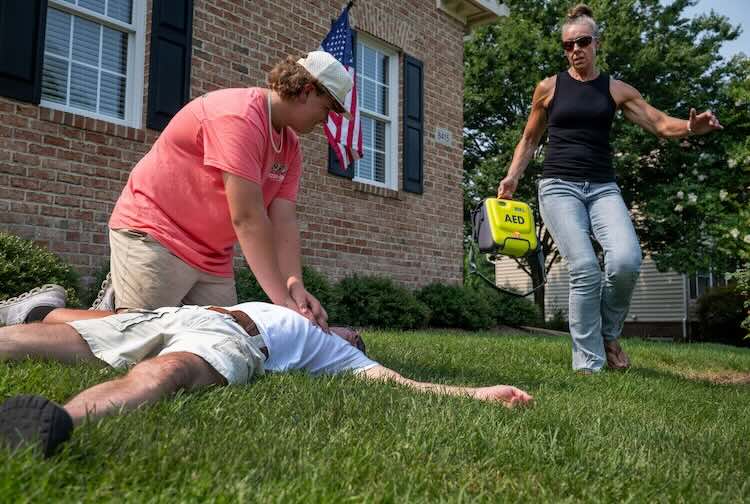 Gavin Scott Sink, David Wigley, and Lisa Walker simulate a cardiac arrest 911 call to see whether a drone can deliver an AED before EMS arrives. (Dean Hoffmeyer, Enterprise Marketing and Communications)
“We are not making any changes to the standard of care that we provide to citizens, but with drone technology, we hope to be able to begin our interventions faster,” said Sgt. Tiara Suggs, specialized response team commander at James City County Police Department. “Our goal is to save lives, protect people, and provide for our communities, and this is just another layer for how we can accomplish that.”
Simulated 911 calls with James City County’s specialized response team have shown promising preliminary results, and in one of the test runs, the drone reached the target location more than five minutes faster than traditional responders.
“Drones won’t replace our EMS providers or patrol officers, but they can enhance our ability to provide earlier lifesaving care and save more lives in our community. The project will determine if we can take our efforts one step further in the race against the clock,” said Battalion Chief Betsy Sink, Emergency Medical Services at James City County Fire Department. “We’re very proud to partner with VCU, Duke Health and the American Heart Association for this project. It really brings together FDA-approved cutting-edge technology and emergency medical services to save more lives.”
The project is laying the groundwork for what the researchers envision will become a large, multi-center randomized clinical trial to better understand the effect of drone-delivered AEDs for improving cardiac arrest survival rates nationally.
“Our hope is that future research will reveal the impact, feasibility and cost of drone first responder systems on a larger scale,” Ornato said.
“Our goal is to show that this is a viable study and that it will lead to even more research,” Sink said. “This is a great stepping stone, and we hope this project will continue to grow and make an impact in saving lives.”
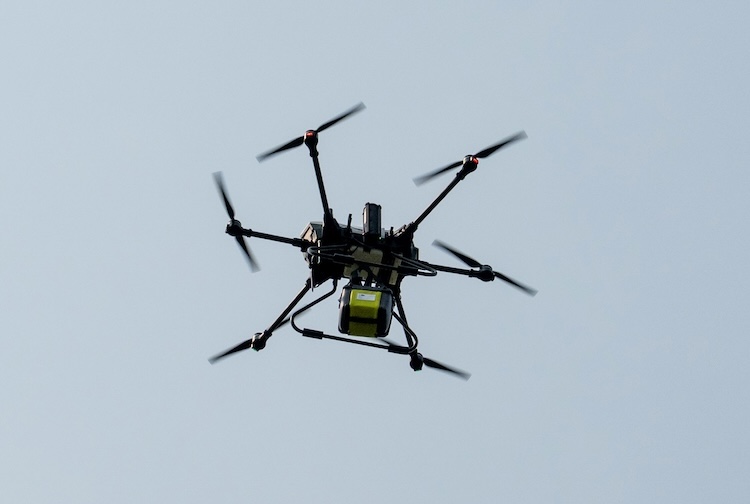 Once on the scene, the drone will hover at 100 feet, lower the AED on a tether directly onto the ground and release it. (Dean Hoffmeyer, Enterprise Marketing and Communications)