Twin sisters survive breast cancer thanks to genetic testing and care at their rural hospital
After a double diagnosis, sisters Lorrie and Beckie credit VCU Health Tappahannock Hospital and Massey Comprehensive Cancer Center for taking their health concerns seriously — saving their lives.
November 18, 2026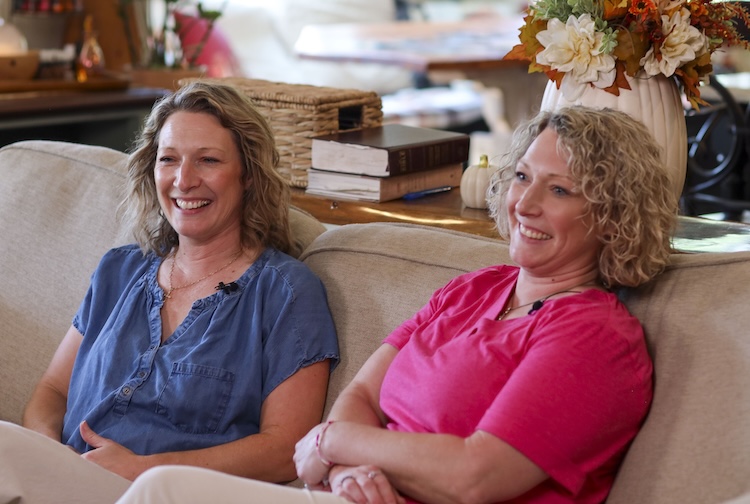 Genetic testing revealed that Beckie Langford (left) carry the same gene that caused her twin sister Lorrie Taylor’s (right) breast cancer. (Bill Potter, VCU Massey Comprehensive Cancer Center)
By Leigh Farmer
In April of 2024, Lorrie Taylor thought the worst was behind her.
It had been one year, almost to the day, since she was diagnosed with a very aggressive form of breast cancer, invasive ductal carcinoma. After enduring chemo, radiation and a double mastectomy, she was in remission and ready for a new chapter.
“It was supposed to be the beginning of life after cancer,” Lorrie recalled.
However, four days after her breast reconstruction, chest pain brought her into the emergency room at VCU Health Tappahannock Hospital – a place she knew well. She had been a nurse there for almost a decade. And while her first round of cancer had been treated by another hospital system for insurance reasons, Tappahannock Hospital was close and familiar.
A routine CT scan didn’t find anything associated with chest pain. Instead, it revealed a tumor growing under her arm.
Lorrie bypassed fear and went straight to anger. She knew about the lump, but her other doctors told her it was nothing to worry about.
“They just kept telling me that there’s absolutely no way that it’s cancer,” Lorrie said.
Twin sisters Lorrie Taylor and Beckie Langford are breast cancer survivors. They share their experience receiving care with VCU Health Tappahannock Hospital and VCU Massey Comprehensive Cancer Center. (Phillip Newsome and Preston Willett, VCU Massey Comprehensive Cancer Center)
Finding a cancer care team that listens to the patient
For round two of cancer treatment, Lorrie knew she needed her home team – VCU Health and VCU Massey Comprehensive Cancer Center.
“I really did feel like I was part of the team there. I met the plastic surgeon, the oncologist, the breast surgeon and the radiologist — I met everybody,” Lorrie said.
Lorrie felt heard and validated after her encounter with the Massey Cancer Service Line (CSL), a programmatic approach that brings together a multi-disciplinary team of specialists to develop the appropriate treatment plan for her. She recalls her husband feeling the same way.
“He said, ‘it is the first time I feel like someone cares about you and wants to do something about it instead of just treating it like another doctor’s appointment,’” Lorrie said.
The 42-year-old mother of four faced another 11 months of intense treatment including chemo, radiation, immunotherapy and surgery to remove the lymph nodes from her arm. Thankfully, most of that treatment could be done close to home at Tappahannock Hospital.
“[Lorrie] always had a positive outlook. She had a lot of family support. Her children would come to see her sometimes. Her husband was frequently here by her side,” said Rebecca Beasley, RN, director of oncology at VCU Health Tappahannock Hospital.
Lorrie was at the hospital’s infusion center nearly every day. “I got very familiar with everyone.”
Cancer care at a rural hospital preserves precious time
Tappahannock is a small town on Virginia’s Rappahannock River, where stories and traditions are passed down from generation to generation. Your neighbors become your family. At VCU Health Tappahannock Hospital, doctors and nurses care for their teachers, pastors and local shop owners. When times get tough, everyone pitches in to help.
“People come out of the woodwork when this happens. They are there asking ‘What can I bring you? What can I do?’” Lorrie said.
“Every community has a form of grit. And certainly, within our rural hospitals, the folks that are out here get things done. They get it done by themselves, whether that’s cutting the timber, whether that’s harvesting oysters, whether that’s running crab pots, whether that’s having to be a jack of all trades in order to survive,” said Josh Hammond, president of VCU Health Tappahannock Hospital.
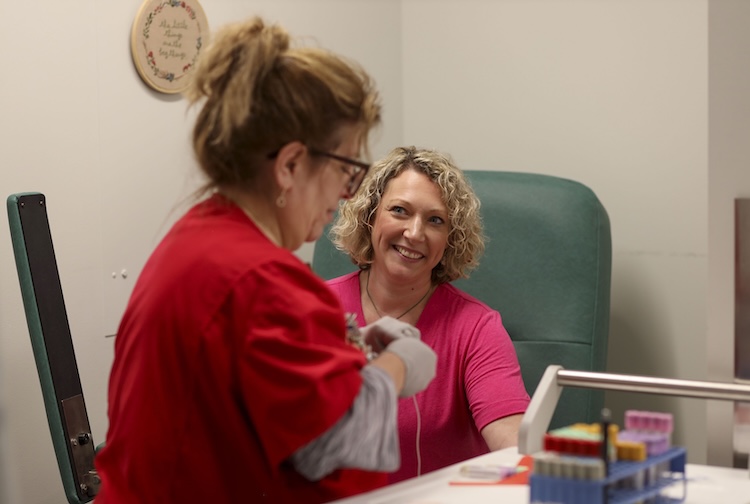 The second time Lorrie Taylor went through cancer treatment, she was able to receive her oncology care at VCU Health Tappahannock Hospital. Being closer to home made treatment days much easier for Lorrie and her family. (Bill Potter, VCU Massey Comprehensive Cancer Center)
In the rural health setting, Hammond says care looks different.
VCU Health Tappahannock Hospital is about a 45-minute drive from the health system’s larger academic medical campus and VCU Medical Center in downtown Richmond. The campus is also home to VCU Massey Comprehensive Cancer Center’s main location. For someone with cancer who lives in rural Virginia, driving that far daily is a significant burden. That’s time away from jobs and family. Commuting to the city and back to the river is a heavy price to pay for treatment.
“It’s time that you’re not doing the things that bring you joy. It’s time that you’re not resting and trying to recover,” Hammond said.
“If you have to drive 60 miles in each direction, that would be the price of a meal. Just the assumption that people have enough income is probably not linked to reality,” said Renato Martins, M.D., chief of the Division of Hematology, Oncology and Palliative Care for VCU Massey Comprehensive Cancer.
Thankfully, as part of the VCU Health System, Tappahannock Hospital is connected to a National Cancer Institute-designated cancer center. This means patients have access to groundbreaking trials, research and care close to home — saving precious time and money for cancer patients in the area.
“It's amazing. My husband would take me to treatments and then we would still have time to get the kids from school,” Lorrie said. “It was so important for them to have as normal of a life as possible while I was going through that.”
“Patients rarely have to do anything in Richmond unless they need more specialized care, maybe certain surgeries, or if they need radiation therapy,” Beasley said.
For Lorrie, it also meant being close to her twin sister, Beckie Langford.
“When we were small, we were built-in buddies, built-in best friends,” Beckie said. “You always had somebody you didn’t have to do anything alone. You had somebody with you.”
Genetic testing for breast cancer leads to double diagnosis for the twins
Like many sets of twins, growing up, Lorrie and Beckie fought for their own identity.
“In high school we were determined to be different,” Lorrie said.
Lorrie is older than Beckie by several minutes. And, according to their mother, Mary Kay Bright, Lorrie has always been the pioneer.
“When they were little, Beckie would always push Lorrie into the room first,” Mary Kay recalled.
Cancer was no different. Three months after Lorrie’s diagnosis, genetic testing revealed that Beckie had the same gene that caused Lorrie’s cancer, called PAL-B2. While scans showed no evidence of cancer in Beckie, the doctors at VCU Massey Comprehensive Cancer Center encouraged her to have a double mastectomy.
“They said basically you are waiting to get cancer or you're going to do something about it before you get cancer,” Beckie said.
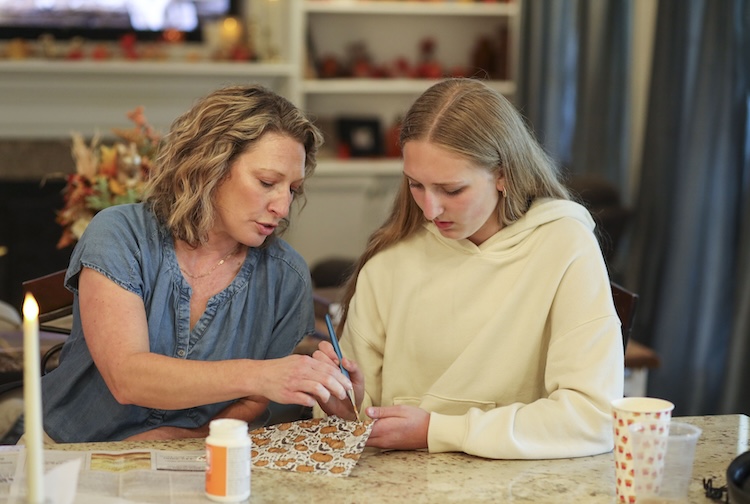 Thanks to genetic testing, Beckie Langford could make informed decisions about how to handle her risk of developing breast cancer. (Bill Potter, VCU Massey Comprehensive Cancer Center)
Just four months later, Beckie made the tough decision to remove her breasts. After the surgery, doctors found hidden and aggressive cancer in the breast tissue removed from Beckie.
“I did not have to have chemo at all. The double mastectomy was the solution to what I had,” Beckie said. “We will never know what that journey would have been.”
Through early detection and genetic testing, Lorrie potentially saved Beckie’s life.
The grit and guts of sisters
It takes grit to get through cancer. It takes guts to remove your breasts based on probability. And in Tappahannock, you'll find plenty of both.
The sisters now dedicate their free time telling anyone who will listen about the importance of early detection.
“Unfortunately, since I’ve gone through this, I’ve had more and more friends that have been diagnosed,” Lorrie said. “I can’t stress enough the early detection, the exams, the mammograms, the genetic testing.”
Both Lorrie and Beckie are here because of their vigilance.
Another thing you’ll find in Tappahannock is oyster shells. When Lorrie was going through treatment, and didn’t have the energy to do much, she would paint the shells and turn them into small jewelry trays, Christmas ornaments and wine stoppers. She now sells them under the name “No Grit, No Pearl.” It’s a homage to what she has been through.
Those shells wash up on the shores of Tappahannock every day. And if you are lucky enough to find an oyster that has endured the rough seas, you'll also find a pearl within it.
That, Lorrie says, is symbolic of the biggest lesson she’s learned: “Anything that’s worth it is going to be hard.”
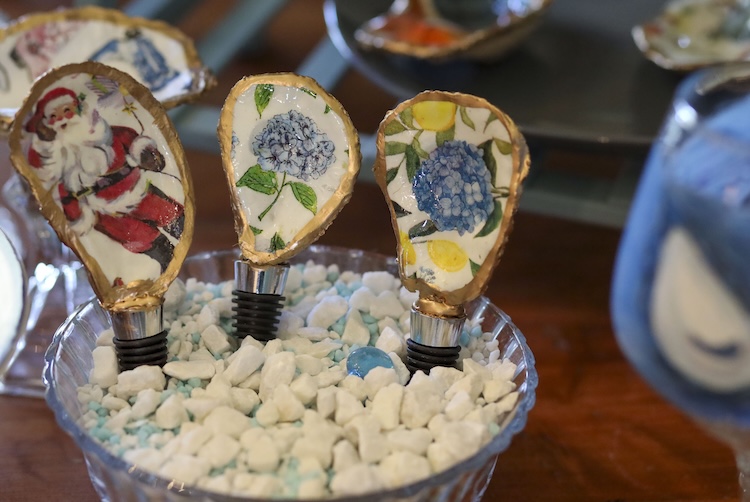 Breast cancer survivor Lorrie Taylor took up a new hobby while going through treatment. Now, she sells her oyster crafts under the name “No Grit, No Pearl.” (Bill Potter, VCU Massey Comprehensive Cancer Center)