Rural Virginia hospital partners with community colleges to train future lab technicians
VCU Health Community Memorial Hospital’s hands-on training program is helping college students launch careers as medical laboratory technicians while strengthening the healthcare workforce in South Hill.
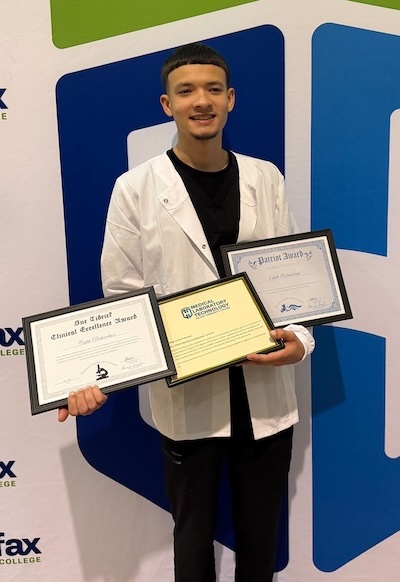
October 08, 2026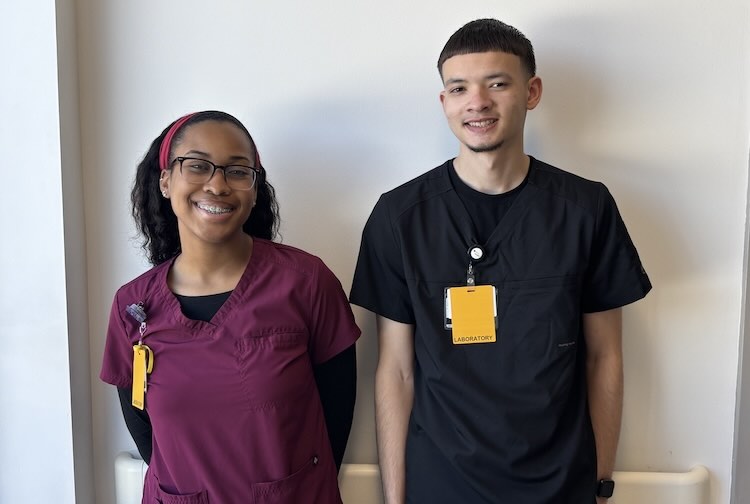 Sherilya Hicks (left) and Caleb Richardson participated in a workforce development program at VCU Health Community Memorial Hospital that gave them hands-on training and experience in medical laboratory technology. (Shea Wright, Enterprise Marketing and Communications)
By Shea Wright
Developing a strong healthcare workforce in rural settings is often a challenge. However, VCU Health Community Memorial Hospital is investing in the development of pathways to train and recruit employees who want to live and work near the South Hill hospital. This includes lab technicians – most of whom a patient will never interact with, directly, but often play a critical role in care.
The Centers for Disease Control and Prevention estimates that approximately 14 billion laboratory tests are performed annually in the United States — and those test results influence about 70% of medical decisions.
Despite this being an important healthcare role, hospitals across the country face persistent challenges of recruiting and retaining medical laboratory professionals.
“Laboratory science is often a hidden but highly rewarding career,” said Chrystal Winstead, BS, MLS, AMT, director of Laboratory Services at VCU Health Memorial Hospital. “We hope to change that by showcasing a behind the scenes look at quality healthcare careers and giving students meaningful clinical experiences both through hands-on clinical training and mentorship.”
At VCU Health Community Memorial Hospital, the recruitment strategy begins outside of the hospital, in the classroom. Because of a relationship with Halifax Community College in North Carolina and a partnership with J. Sargent Reynolds Community College in Virginia, students pursuing careers in medical laboratory technology can get first-hand experience working and training in the rural hospital setting.
“As educators, we’re not just preparing students to graduate. We’re helping prepare the next generation of laboratory professionals who will serve patients and communities for years to come,” said Kimberly Rose, BS, MLS, ASCP, SBB, a medical laboratory technician instructor and clinical coordinator at J. Sargent Reynolds Community College. “Thanks to the partnership with VCU Health, our students spend their final semester in clinical rotations. It gives the hospital an opportunity to get to know our students in a way that is much like a real interview — seeing how they interact with staff, communicate and carry themselves professionally.”
“When people hear that someone works in a hospital, they often assume you are a nurse, a doctor, a phlebotomist,” said Caleb Richardson, a recent Halifax Community College graduate who had clinical training at CMH. “But [laboratory services] are really at the heart of a patient’s care team, producing information that helps nurses, physicians and other healthcare professionals make decisions about a patient's care. That’s what led me to want to become a technician.”
A career in healthcare had been on Richardson’s mind since high school. He knew he wanted to help patients, but he also knew traditional bedside care wasn't necessarily the right fit.
Now Richardson and fellow trainee Sherilya Hicks are fulltime lab technicians at CMH. For both students-turned-hospital-team-members, finding mentorship in South Hill solidified why they chose this career path and their long-term interest in the community.
The result of this investment in the next generation of medical laboratory professionals is a rural healthcare workforce-development pipeline that connects access, education, hands-on training and, eventually, full-time employment opportunities.
Medical laboratory technicians: Unsung heroes of patient care
Lab technicians work behind the scenes to analyze blood, tissue, urine and other bodily fluids to help care teams diagnose and treat patients. CMH’s Laboratory Services provide clinical chemistry testing, hematology testing, and molecular microbiology testing.
The CMH team also plays a critical role in supporting both emergency and surgical services by ensuring timely availability of routine and emergency blood products. That means the hospital’s lab technicians coordinate blood transfusions for patients undergoing scheduled surgical procedures as well as those experiencing life-threatening traumatic events.
“One of the greatest strengths of our profession is the variety of opportunities it offers. Individuals with highly analytical minds may be drawn to areas such as chemistry or toxicology. Others interested in investigation and interpretation may find microbiology or transfusion medicine exciting,” Winstead said. “Each discipline offers unique challenges and rewards, allowing future professionals to find a path that aligns with their interests and strengths.”
Laboratory science is often a hidden but highly rewarding career. We hope to change that by showcasing a behind the scenes look at quality healthcare careers and giving students meaningful clinical experiences both through hands-on clinical training and mentorship.
Chrystal Winstead, BS, MLS, AMT, director of Laboratory Services at VCU Health Memorial Hospital
Hicks sees the role of lab technicians from a unique perspective. She once envisioned becoming a labor and delivery nurse, but while learning about wound care, she found herself increasingly interested in specimen collection and testing.
Being on the analytical side of healthcare is “the coolest thing,” she says, since it is an opportunity to deliver patient care from a different perspective.
“Nurses and other bedside clinicians can see what is happening with the patient on the outside, while laboratory professionals get a glimpse of what is happening on the inside,” she said.
Hands-on college experience in a Virginia hospital
For CMH, providing clinical experiences is more than fulfilling an educational requirement. It's an opportunity to welcome the next generation of healthcare professionals into the community.
Students rotate between clinical sections, with each area of the lab having its own processes and quality-control procedures. Once those rotations are complete, students work alongside their instructors to test patient specimens and learn how results are reported.
Working so closely with the team at CMH gave me the confidence to trust my results and the instrumentation. That level of hands-on training is one of the reasons I knew I wanted to stay.
Caleb Richardson, a laboratory technician at VCU Health Community Memorial Hospital
“We take great pride in providing a supportive learning environment that fosters growth, encourages continuous learning and allows students the opportunity to learn from mistakes in a constructive setting. As laboratory leaders and educators, it is our responsibility to cultivate and develop future scientists by providing them with the knowledge, skills and confidence needed to succeed,” Winstead said.
For Hicks, technical training wasn’t the only element that made clinical experiences worthwhile. It was the people.
“Everyone is willing to teach you and help you understand what you need to know,” Hicks said. “The staff here is extremely knowledgeable and understands the importance of teamwork and how critical our role is to the health of every patient.”
Richardson echoes those sentiments. “I felt like I was getting the best training at CMH. Everyone was willing to help and didn’t make you feel bad if you didn’t know something right away.”
That environment also turned a clinical placement into a place where both students could imagine building their careers.
Supporting students helps to build rural pathways to healthcare careers
 Supporting students helps to build rural pathways to healthcare careers
For some students, however, access to clinical training presents another challenge, distance.
Richardson, who lived in North Carolina, faced a commute that could have added several hours to his clinical days. Before he learned about CMH, he was considering working at a clinical site about 3 hours away from home.
“Days in the lab often start early at 5 a.m.,” Richardson said. “If I had to spend that time commuting across the state of North Carolina, I would have to get up at 2:30 a.m. every day just to start my day.”
At CMH, students who have long commutes can have a home while at the hospital. The hospital has dormitories used by medical laboratory students as well as students in their medical residency program.
“I would be exhausted traveling back and forth each day,” Richardson added. “Having a dormitory site at CMH gave me time to study, sleep, and have a little time to myself, while getting my clinical hours.”
Leadership at VCU Health recognizes how students invest a lot of time, money and energy to reach their career goals. So CMH is investing in them by creating the dormitories as a respite after a long day of learning. The dormitories, which were initially for family medicine residents, have since evolved to allow any student in need of a place to stay on the hospital’s campus.
“The fact that students are willing to make that commitment speaks volumes about the positive culture, supportive learning environment and professional opportunities we provide,” Winstead said. “It is especially rewarding to watch these students grow into skilled laboratory professionals and future leaders within our organization.”
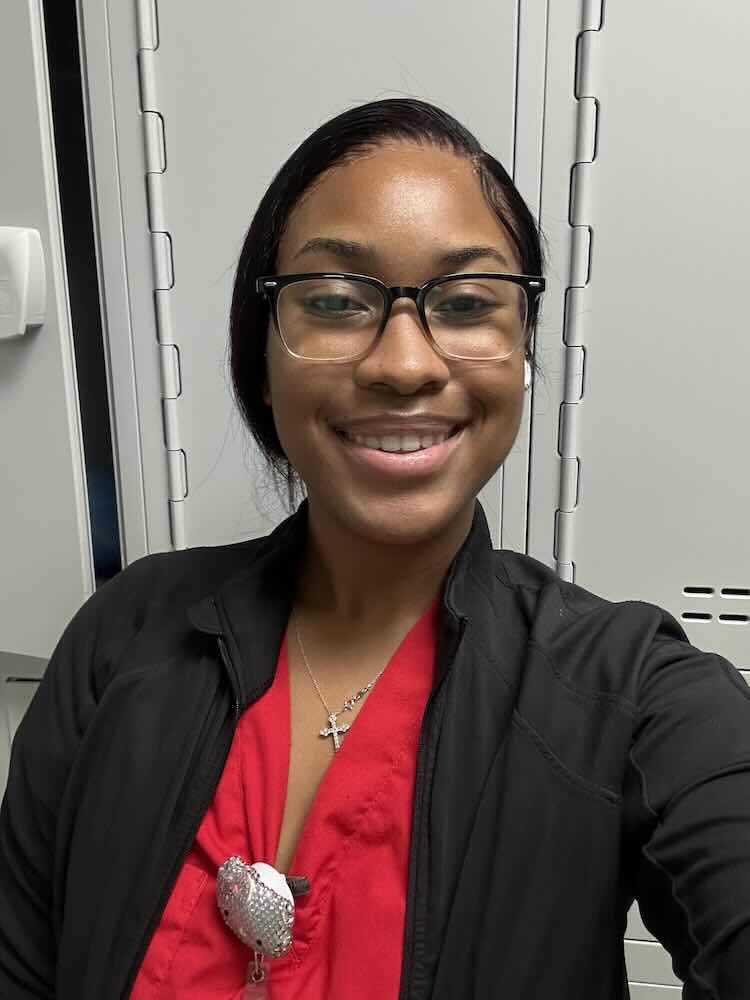 Sherilya Hicks, a laboratory technician at VCU Health Community Memorial Hospital, says she is excited to begin her career in the same place where she completed her clinical training. (Contributed photo)
Looking towards the future
Hospital laboratory technicians can enter the field with a two-year associate degree. While working in the lab, they can continue their education to become medical laboratory scientists, typically by earning a bachelor’s degree.
Medical laboratory scientists perform more complex testing and analysis than technicians, often taking on additional responsibilities within the laboratory. With experience and additional education, these healthcare professionals can also move into roles in clinical supervision, laboratory management, technical specialties, laboratory information systems, research and development, forensics and the pharmaceutical industry.
“Working so closely with the team at CMH gave me the confidence to trust my results and the instrumentation. That level of hands-on training is one of the reasons I knew I wanted to stay,” Richardson said.
“When I started out, I didn't even know medical laboratory technology was a career I could pursue,” Hicks said. “Now I'm getting ready to begin my career in the same place where I completed my clinical training. I'm excited to keep growing, learn even more and know that the work I'm doing behind the scenes is helping take care of patients.”