Paying it forward: Student interest group helps VCU undergrads navigate the path to medical school
Through MedMentors @ MCV, current School of Medicine students provide personalized guidance for prospective applicants.
September 09, 2026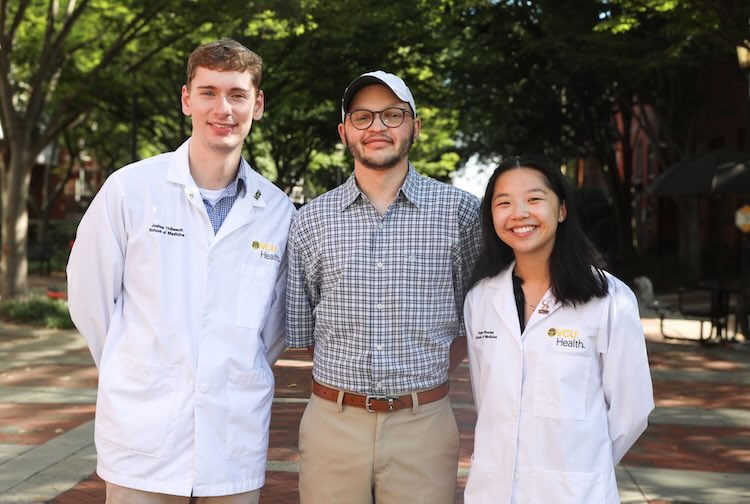 (Left) MedMentors @ MCV president Josh Thibeault with mentee-mentor duo Shady Habib, a VCU senior, and Hope Rhodes, a third year medical student, who were matched by the student interest group (Arda Athman, VCU School of Medicine)
By Grace McOmber
The past year of Virginia Commonwealth University senior Shady Habib’s life has been dedicated to reaching for a dream he’s been preparing for since he was a kid — medical school.
As an applicant in the 2026-2027 admissions cycle, Habib has spent countless hours refining his resume, meeting with advisors and writing personal statements detailing what makes him stand out. Throughout it all, he can count on having at least one person in his corner — second-year VCU School of Medicine student Hope Rhodes.
Habib and Rhodes are one of the duos matched by MedMentors @ MCV, a medical student interest group dedicated to pairing current School of Medicine students with junior and senior VCU undergrads applying to U.S. medical schools. In one-on-one meetings, the mentors guide their undergrad mentees through the multi-step, year-long process of applying to medical school, a time the mentors are not too far removed from themselves.
“Everyone in this field has climbed the same ladder,” said Josh Thibeault, a third-year medical student and the president and founder of MedMentors. “I think it’s an innate desire for those in medicine to help those that come after you, because we’ve all been the pre-med undergrad, or the applicant or the medical student before.”
Learning from experience
Since its founding earlier this year, MedMentors has worked to match more than 85 medical student mentors with junior and senior pre-medical VCU undergraduate students. Each prospective mentor and mentee submits information about themselves to Thibeault and other SIG leaders, detailing the “why” behind their desire to become a physician.
For Thibeault, MedMentors is a way for him to pass along the mentorship that helped him get into medical school. He himself applied to medical school four times before being accepted. As the first in his family to pursue medicine, he remembered not having much insight into the process beyond the “hard requirements,” like a high GPA, strong MCAT score and volunteer hours, when it came to his application.
“I just really didn’t understand what they were looking for. I would check the average MCAT scores for a school, see if mine matched up, and think that was enough,” Thibeault said. “It was really frustrating, because I didn’t understand where I was falling short.”
He attributes his success after multiple attempts to the four gap years he took between undergrad and getting into the School of Medicine. During that time, he scribed in an orthopaedic clinic and did clinical research in ophthalmology. Working closely with physicians, Thibeault said, helped him recognize which attributes made them successful. Through trial and error, Thibeault learned the importance of being able to “show, not tell,” why he would be a good medical student at schools that aligned with his interests and experience.
“There is so much information out there about what makes a ‘good applicant’ that it can get overwhelming,” Thibeault said. “Having an actual person who knows you and can see what makes you stand out means that their advice can be more tailored. It really makes a difference.”
Aside from matching mentees with mentors, Thibeault purposefully takes a hands-off approach as the group’s president. He encourages the pairings to establish their own dynamic, make their schedules and define their own goals.
“Sometimes mentors spend a lot of time going over specific questions, but there are also times when a mentee just needs to hear that things are going to be okay,” Thibeault said. “Meeting someone where they are, in my experience, can be very powerful.”
A helping hand
Habib first learned about MedMentors in an email he received in his university inbox. Just a few days later, he was on a Zoom call with Rhodes, ready to discuss his goals for the application cycle.
“Their process must be really comprehensive, because Hope and I are so alike in a lot of ways,” Habib said. “Meeting someone who has a similar purpose for going into medicine and has successfully gotten into medical school is really reassuring.”
Over the past year, Habib and Rhodes have worked together on every phase of the application cycle — a process that can take anywhere from 15 to 18 months. From the very beginning, Rhodes helped Habib determine which schools he was most interested in applying to and how his specific skills and experiences could make him a competitive candidate.
“I really wanted to make sure he knew that it wasn't just about what he offered these schools, but also what these schools would offer him,” Rhodes said. “Every school has its own culture, and you really have to be able to visualize yourself there as well.”
Habib spent much of the summer between his junior and senior years navigating the secondary applications phase — when medical schools send out supplemental essay prompts to evaluate if applicants align with the school’s mission and values. It's a challenging portion of the process that requires applicants to submit multiple high-quality essays in a two-week timeframe. Having someone who understands that difficulty, and how to get through it, has helped Habib feel less overwhelmed.
“A lot of my friends aren’t pre-med, so having an individual connection with someone who is embedded in medicine, but isn’t that far ahead of me, has been really beneficial,” Habib said. “MedMentors is a great program because it meets undergrads where we are.”
For Rhodes, working with someone to achieve their personal goals has not only reinforced why she wanted to be a mentor, but also why she wanted to be a physician.
“I learn so much from him, as well,” Rhodes said. “Listening to his perspective, understanding where I can come in and how we can work together to get there is also practicing the skills I’m going to need in my career.”
As Habib progresses through the rest of his secondary essays and into interview season in the fall, he is confident that Rhodes will be a cheerleader for his success along every step of the journey.
“It can be such a hard time to navigate, and there is so much out there about what to do and what not to do,” Habib said. “MedMentors has been really useful in breaking down those barriers and has made me feel more comfortable throughout the application cycle.”
Stay informed, stay healthy. Sign up for VCU Health’s e-mail newsletter.