‘It felt like a miracle’: Patient with Parkinson’s disease able to hug again thanks to VCU Health
Using innovative deep brain stimulation procedure, VCU Health neurosurgeons provide better quality of life to those living with Parkinson’s disease.
July 28, 2026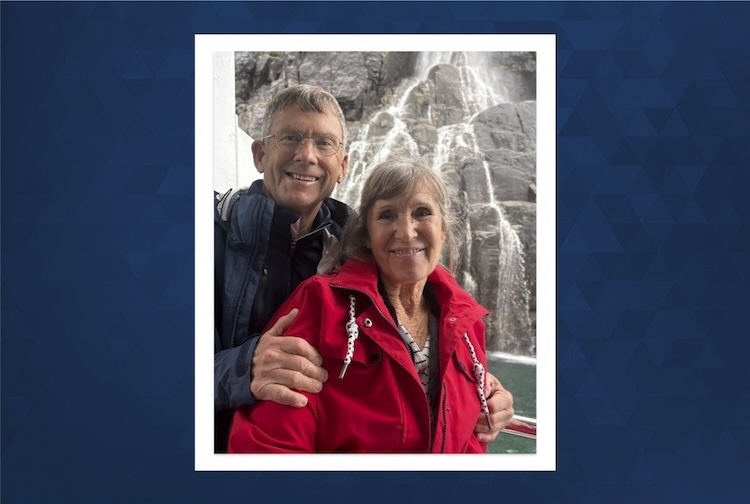 VCU Health patient Chalmers “Chal” Nunn says “it felt like a miracle” to be able to hug his wife, Catherine Koplinka Nunn, after years of struggling with side effects of Parkinson’s disease medications. (Enterprise Marketing and Communications)
By Leigh Farmer
Chalmers “Chal” Nunn has worn many hats — athlete, doctor, husband, dad, golfer and community leader just to name a few.
“People often call me the mayor. If I see something is not right, I jump in and do it,” said the 72-year-old Clarksville, Virginia native.
But there is one common thread through all of it — his hugs.
“It’s more important to hug than it is to shake hands.”
So, when he couldn’t give a good squeeze anymore, he knew something had to be done.
“I’m not a ‘hide my disease’ type of guy. I know all of the waitresses and the convenience store clerks are tired of hearing me say ‘I’ve got Parkinson’s and that’s the way I’m going to be.’”
Chal was diagnosed with Parkinson’s disease in 2017 after several years of unexplained back, neck and knee pain, as well as several corrective orthopedic surgeries to try to alleviate it.
Parkinson’s is a neurodegenerative disorder that primarily affects a person’s movement. Symptoms include tremors, slow gait and muscle stiffness. At its worst, the disease renders a person unable to move or talk.
“My voice. It’s not right. It’s terrible. No matter how many excuses I make, no matter how hard I try,” said Chal, who loves to talk and connect with others. He gets especially excited when he can connect with someone who isn’t like-minded.
“Relationships make the world go ‘round,” Chal said.
But Parkinson’s had begun to take it all away.
“I was a shell of myself — physically and emotionally,” recalled Chal. And he knew there wasn’t much that could be done to make his situation better.
There is no cure for Parkinson’s disease, only treatment for the symptoms. Nearly one million people in the U.S. are living with it, and another 90,000 people are diagnosed annually, according to the Parkinson’s Foundation.
Upon diagnosis, Chal began taking levodopa, a very common Parkinson’s drug that addresses the primary characteristic of the disease, dopamine deficiency.
Unfortunately, it wasn’t long before the side effects of the medication became unbearable.
“I’m a big hugger, but I just couldn’t do it anymore,” Chal said.
Treating Parkinson’s disease symptoms and medication side effects
Chal’s neurologist referred him to VCU Health for further treatment at what he describes as the lowest point in his life.
“You could feel the distance the dyskinesias were creating,” Chal said.
Dyskinesia, often a signature characteristic of Parkinson’s for a layperson, is actually a side effect of the medication used to treat the disease.
“I often call them the Michael J. Fox wiggles because people have seen Michael J. Fox with the extra movements and it can be extremely profound,” said Kathryn Holloway, M.D., a neurosurgeon with VCU Health and the director of VCU Health’s Deep Brain Stimulation Program.
Chal sought Holloway’s expertise after learning about a treatment called deep brain stimulation (DBS) from his neurologist.
“Lots of times, the referring or treating neurologist is not familiar enough and doesn’t recognize the benefits of DBS,” Holloway said. “Here at VCU Health, we’re blessed with having an extremely skilled team of movement disorder neurologists that understand exactly when someone can benefit.”
I went into that operating room and there were 12 people there. And they were all there to help me. That’s 12 people who care about me enough. I was thinking ‘how lucky am I.’
Chalmers “Chal” Nunn, VCU Health patient
Parkinson’s disease affects the dopamine-producing neurons in the region of the brain that affects movement. DBS is a surgical treatment that involves placing electrodes in those specific areas to regulate abnormal brain activity to stop the wiggling.
“If you have true Parkinson’s disease, you will eventually need DBS because eventually the medication will no longer do the job properly,” Holloway said.
The electrodes that administer DBS can be adjusted like a radio signal. As a patient’s Parkinson’s disease progresses, the signal can be turned up or down by a neurologist for optimal results. Simply put by Holloway: “DBS is the insertion of an adjustable, reversible off switch in the brain.”
The DBS that is now administered at VCU Health is called a “closed loop,” which means that it can be auto-adjusted based on feedback from the patient‘s brain. There is minimal need for physician intervention.
As a physician, Chal knew the risks of surgery. But he also knew the reward.
“I was at a point where I had no choice. There was nothing else that could be done. I needed to take what this treatment could give me,” recalled an emotional Chal. “I went into that operating room and there were 12 people there. And they were all there to help me. That’s 12 people who care about me enough. I was thinking ‘how lucky am I.’”
How VCU Health is a national leader in deep brain stimulation and neurosurgery research
Holloway and her team have not only been administering DBS for years, they are also working to constantly improve procedures that address Parkinson’s disease and other movement disorders.
“We’ve built this up over the years,” Holloway said. “We used to burn holes in the brain. And that could be very effective, but it wasn’t adjustable and reversible. If you had a side effect, you would be stuck with it."
She and her team began implanting deep brain stimulators in the late 1990s. And by the early 2000s, they were involved in national studies to further improve the technology and determine if providing DBS to Parkinson’s patients on top of their medication was a benefit.
Here at VCU Health, we’re blessed with having an extremely skilled team of movement disorder neurologists that understand exactly when someone can benefit.
Kathryn Holloway, M.D., director of VCU Health’s Deep Brain Stimulation Program
Further studies have allowed Holloway to examine the nuclei targeted when the electrodes are put into a person's brain. Her continued involvement in the research, she says, provides her with the confidence to do this type of surgery while her patients are asleep. This was not always the case. For many years, patients were put to sleep for the initial uncomfortable parts of the surgery, then awakened for testing and adjustment.
“Now with intraoperative imaging and much better MRI imaging, as well as a better grasp of where we need to target with nuclei, we offer surgery with the patient being completely asleep,” Holloway said.
Improving the quality of life for patients with Parkinson’s disease
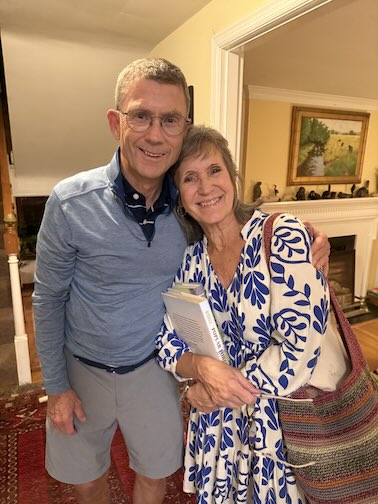 Chal Nunn, a VCU Health patient who is living with Parkinson’s disease, and Catherine Koplinka Nunn, his wife. (Contributed photo)
Here’s the kicker with DBS — the results are not instantaneous. The electrodes must heal and settle in the brain before the device can be turned on. That takes about six weeks. But Chal will tell you, the reward was worth the wait.
“It felt like a miracle,” Chal recalled. “My wife and I held a long, comfortable embrace for the first time in years. That moment changed my life.”
Holloway says the impact this procedure has on patients emotionally is just as notable as the motoric improvement. DBS helps to prolong a person’s quality of life.
“It’s a progressive disease and eventually you will need everything we’ve got,” Holloway said.
Decades of working with Parkinson’s patients provides her with a deep understanding and empathy.
“It’s pretty easy to see how the most basic things become frustrating. Being able to reach for something and have a secure grab on it and for it to come to your mouth and not shake all over the place,” Holloway said. “There are so many things we take for granted.”
Chal still has bad days. But, despite those tough moments, he still makes every day count.
“People always tell me ‘you need to slow down Chal.’ If I slowed down, I’d be dead.”
He runs golf tournaments as the president of his state golf association, provides leadership counsel to physicians and, most importantly, gives out every hug he can.