Patient-founded fund helps medical student showcase her ALS research
Ally Tegner is interested in the mental health aspects of treating patients with chronic progressive diseases, such as ALS, which can be challenging to diagnose.
August 13, 2026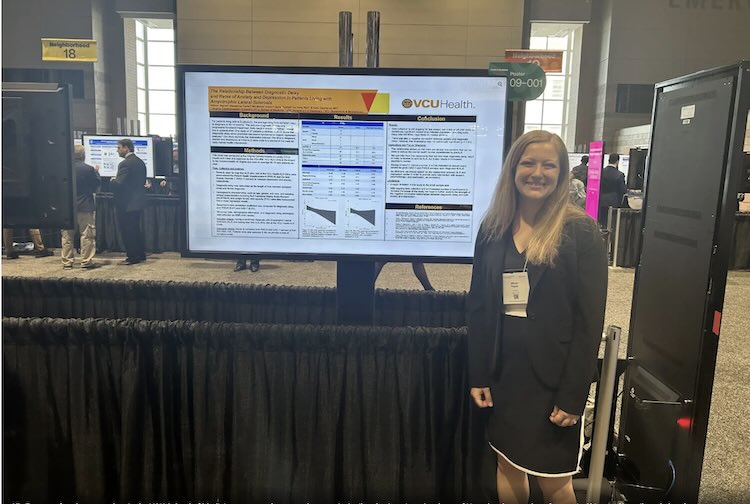 Ally Tegner, a fourth-year student in the VCU School of Medicine, presented a research poster in April at the American Academy of Neurology’s annual conference in Chicago. (Contributed photo)
By Chelyen Davis
Virginia Commonwealth University fourth-year medical student Ally Tegner wouldn’t normally attend the American Academy of Neurology’s annual conference in Chicago.
For one thing, she aspires to become a pediatrician, not a neurologist. She’s also a medical student, with a limited budget that wouldn’t necessarily include money for days at a professional conference.
But two things converged to get Tegner there: A lecture on the work of VCU Health’s ALS Clinic that so intrigued her that she developed a research project around patients with ALS — also known as Lou Gehrig’s disease — and support from the Harper’s Hope Fund.
Tegner learned about the Harper’s Hope Fund from Kelly Gwathmey, M.D., who at the time was director of VCU Health’s ALS Clinic, and who oversaw Tegner’s initial research. Without support from Harper’s Hope and the Department of Neurology leadership, Tegner’s experience in Chicago would have been brief, if she was able to go at all.
The financial support allowed Tegner to attend the entire three-day conference in April, explore more educational sessions and fully engage in the experience. As a student, having those expenses covered removed a major source of stress and made the opportunity possible, she said.
Her poster on “The Relationship Between Diagnostic Delay and Rates of Anxiety and Depression in Patients Living with Amyotrophic Lateral Sclerosis (plwALS)” was one of about 200 selected for presentation at the conference, she said, but one of only six featured on a poster tour for attendees.
Supporting the patient and their mental health
ALS is a progressive neurodegenerative disease that affects nerve cells in the brain and spinal cord. It eventually impacts the person’s ability to speak, swallow and even breathe. There is currently no cure.
The Harper’s Hope Fund was founded in 2014 by Vic Harper, a patient in VCU Health’s ALS Clinic, and his family. Harper recognized the high costs of supportive equipment for patients with the disease as well as the need for more research into ALS and more public awareness of the disease. The fund accepts donations and is used to assist ALS research, education and outreach, and support for patients and families.
Tegner was introduced to the VCU Health ALS clinic in her second year in the VCU School of Medicine. She was impressed by the focus on multidisciplinary care. A patient at the clinic will see multiple clinicians on their care team in the same visit, since it can be difficult for ALS patients to travel.
“Caring for the patient over long periods of time resonated with me, forming that relationship,” Tegner said. “Going into pediatrics, I’m very invested in mental health aspects and helping patients.”
She’s especially interested in the mental health aspects of treating patients with chronic progressive diseases, such as ALS, which can be challenging to diagnose. On average, people with symptoms can wait 10-16 months before receiving a diagnosis, a delay that adds to their stress and impacts their mental health.
“It’s a very mentally burdening disease to experience or have a loved one diagnosed with,” Tegner said.
There isn’t a formal method for assessing patients’ mental health in their initial visit to the clinic, so she decided to study how an ALS diagnosis can relate to depression.
“Is there somewhere early on in the initial visit that we could intervene in the mental health aspect that’s missing right now?” she said.
Her research involved giving patients two depression diagnostic surveys on their initial clinic visit. For her AAN poster, she looked at the initial data for a small sample size of 24 patients and found that, indeed, ALS patients arrive at the first visit in need of more mental health support.
“We saw that both with anxiety and depression, patients do have significant ratings with the surveys,” Tegner said. “There is a need to intervene earlier with counseling or pharmacological interventions.”
Expanding the care team
Tegner is working to grow her research to 100 patients, and continue to collect data, with plans of writing a journal article.
Tegner hopes her research will lead to psychiatrists and other mental health professionals becoming part of the multidisciplinary care teams that treat ALS patients, and that clinicians give greater attention to the mental health impacts of being diagnosed with an incurable, progressive disease.
“There's significant anxiety and depression in getting diagnosed with this disease and having uncertainty for so long,” she said. “Overall, I'm hoping to be able to recognize this and intervene earlier, even in that initial visit … be able to get these patients counseling and start therapies if necessary to help with their mental health burden — to do anything we can to really help patients with this progressive disease.”
Stay informed, stay healthy. Sign up for VCU Health’s e-mail newsletter.