The Overlooked Hormone: How VCU Health experts are rewriting the narrative on estrogen and aging
From bone to brain health, VCU Health clinicians are using the latest research on estrogen and menopause to help women age gracefully.
July 31, 2026 While estrogen is commonly associated with the reproductive system, the hormone impacts many areas of the body. (Getty Images)
By Konrad Solberg
Conversations about menopause and aging for women have largely been characterized by a narrow list of experiences like hot flashes, mood swings and other discomforts that many women think they must endure. But estrogen decline is linked to a complex web of systemic biological changes.
Most people know of estrogen as a hormone associated with the reproductive system, but it actually has a role in everything from the structural strength of our bones to the microscopic environment of the bladder and the brain’s metabolic health.
Because of its relationship to numerous systems, the physical effects of estrogen decline during the menopausal transition can be widespread, deep-seated and occasionally life-threatening.
At VCU Health, an academic health system connected to Virginia Commonwealth University, experts from different corners of medicine are pooling their insights to demystify the impacts of estrogen decline.
Through advanced clinical care, preventative screenings and interdisciplinary collaboration, they are empowering patients to reclaim their quality of life and acknowledging the symptoms of something all women inevitably endure — estrogen decline.
Estrogen levels and the silent skeletal shift
The skeletal system may feel permanent and unchanging, but in reality, bone is a dynamic, living tissue that completely replaces itself every ten years.
Throughout our 20s, 30s and 40s, this process remains balanced thanks to two types of cells: osteoclasts, which break down old bone, and osteoblasts, which build new bone.
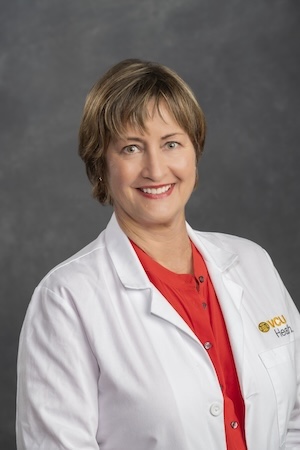 Margaret Krebs, ANP, leads the fracture prevention program with VCU Health Orthopaedics. (Enterprise Marketing and Communications) But this interplay relies heavily on estrogen, said Margaret Krebs, ANP, an adult nurse practitioner who leads the fracture prevention program with VCU Health’s orthopaedics team.
“Estrogen is highly protective of bone tissue,” Krebs explains. “When women go through natural or surgical menopause and estrogen levels plummet, they lose an average of 20% of their bone density in the first year. It is a massive structural shift.”
This imbalance starts with intermediate thinning of the bone, osteopenia, but can lead to the more advanced form of bone deterioration, osteoporosis. Because thinning bones don’t typically cause physical pain, osteoporosis can often go undiagnosed until a fracture occurs. And if a parent suffers a hip fracture — from a ground fall, for example— could be an indication that their children are at an increased risk for osteoporosis due to lower bone density.
“Suddenly, you have a major imbalance where more bone is being broken down than built,” Krebs said.
This imbalance starts with intermediate thinning of the bone, osteopenia, but can lead to the more advanced form of bone deterioration, osteoporosis. Because thinning bones don’t typically cause physical pain, osteoporosis can often go undiagnosed until a fracture occurs. And if a parent suffers a hip fracture — from a ground fall, for example— could be an indication that their children are at an increased risk for osteoporosis due to lower bone density.
Currently, national guidelines don’t recommend a bone density scan until age 65, but the average age of menopause in the United States is 52. And delays in diagnosis can have devastating consequences.
“We are already 13 years behind the curve by the time standard screenings happen,” Krebs said.
Early diagnosis is vital, especially given that 20% of patients with an osteoporotic hip fracture die within a year, due to subsequent medical complications and loss of autonomy.
The danger of urosepsis: Estrogen and pelvic health
While bone thinning can go unnoticed, estrogen decline in the pelvic region can bring more immediately distressing symptoms, which are often misunderstood and misdiagnosed.
Julie Suyama, M.D., Ph.D., a VCU Health urogynecologist who specializes in pelvic health and an assistant professor of Urogynecology and Reconstructive Pelvic Surgery at Virginia Commonwealth University School of Medicine, says that despite its critical role in maintaining health across various organ systems and across a woman’s entire lifespan, estrogen has been portrayed in ways that tend to scare patients.
“There is extensive public discussion about the risks of giving estrogen to patients,” Suyama said, “but very limited discussion about the profound risks of leaving patients estrogen deficient.”
Women deserve to be heard, and they deserve to live comfortably and vibrantly at every stage of life.
Julie Suyama, M.D., Ph.D., a VCU Health urogynecologist
Suyama emphasizes that the bladder, urethra and vaginal tissues are densely coated in estrogen receptors. When estrogen levels drop because of menopause, postpartum lactation or use of hormonal contraceptives, women can develop the condition known broadly as hypoestrogenism. The condition causes these tissues to lose their elasticity, volume and vital blood supply. With those changes, various pelvic floor and urinary symptoms can arise, including intense bladder urgency and urinary frequency, pressure and pain.
“Countless women visit urgent care clinics thinking they have a urinary tract infection,” Suyama said. “A preliminary urine dipstick might look abnormal due to contamination with cells that are always present in the vagina, so women are frequently started on unnecessary antibiotics. But when the final culture comes back, it’s completely negative. Their symptoms aren’t indicative of an infection — it’s a direct result of low estrogen.”
A healthy vaginal microbiome relies on estrogen to maintain lactobacillus, a natural probiotic that fends off dangerous bacteria. When estrogen levels drop, lactobacilli die off, opening the door to genuine chronic UTIs and bacterial vaginosis. If left untreated in older populations, these localized infections can easily progress into urosepsis, a leading cause of hospitalization and death in patients over the age of 80.
A metabolic crisis in the brain
The human brain relies almost exclusively on glucose to power its daily executive functions. But estrogen serves as a critical biological mediator for this metabolic process. When estrogen levels begin fluctuating, often starting quietly in a woman’s late 30s or early 40s, the brain’s ability to process glucose becomes impaired.
 Julie Suyama, M.D., Ph.D., a urogynecologist with Women’s Health at VCU Health. (Enterprise Marketing and Communications)
To prevent a crisis of energy, the brain seeks alternative fuel sources. First, it begins burning amino acids, the building blocks needed to synthesize crucial neurotransmitters like dopamine, norepinephrine and serotonin. This sudden deficit frequently manifests as profound brain fog, sleep disturbances, anxiety and new-onset depression. Even more concerning is what happens when those amino acids aren’t enough: the brain can begin consuming itself for fuel.
“Cognitive neuroscientists and neurologists who focus on the intersection of hormones and neurologic disease are just hitting the tip of the iceberg,” Suyama said. “Shockingly, almost 70% of Alzheimer’s patients are women, and about 80% of autoimmune disorder patients are women. Emerging data shows that chronic estrogen deficiency plays a highly complex role in these neurodegenerative and immune dysfunctions.”
Evidence-based solutions tailored for each woman’s healthcare needs
Despite the systemic challenges of estrogen decline, the team at VCU Health emphasizes that these conditions are highly treatable through personalized, proactive interventions.
For bone and joint preservation, Krebs says she favors progressive resistance training. Pointing to insights from clinical trials like the LIFTMOR study, she works closely with physical therapists to build targeted strength routines for elderly patients.
“I used to hate this, but motion is lotion,” Krebs laughs, sharing a favorite physical therapy saying. “We teach our older patients exercises like the ‘sit-to-stand,’ where they cross their arms and rise from a chair and sit back down. This simple movement strengthens the quads, hamstrings and glutes, which form the primary structural support for aging hips and knees.”
Krebs also guides patients through optimal dietary and supplemental strategies, routinely steering patients over 35 toward calcium citrate over calcium carbonate for superior absorption. Maintaining adequate calcium keeps the body from robbing calcium directly from the bones to keep the heart’s electrical rhythms stable.
On the pelvic health and systemic front, Suyama is working to dismantle outdated fears surrounding hormone replacement therapy. She regularly utilizes localized vaginal estrogen, which is entirely safe and effective for treating bladder irritation and preventing urinary tract infections. For systemic symptoms like debilitating brain fog and insomnia, modern transdermal estrogen patches can be used safely in almost all women.
“When estrogen is taken orally, it goes through the liver, which can inadvertently increase clotting factors, stroke risks or heart attack risks,” Suyama said. “But a transdermal patch delivers estrogen directly through the skin, completely bypassing liver metabolism. It carries zero increased risk for clotting from a patient’s baseline.”
Suyama recalls a patient who had been told by previous providers that she could never safely use estrogen because she previously had a heart attack, leaving her to endure years of severe brain fog, mood disturbances and physical pain.
“When I explained the safety data of transdermal estrogen patches to her and collaborated with her cardiologist, she literally began crying with relief in my office,” Suyama said. “Seeing the patient return six weeks later and say, ‘I finally feel like myself again,’ is exactly why we do this work. Women deserve to be heard, and they deserve to live comfortably and vibrantly at every stage of life.”